
Agios Pavlos and Cape Melissa: Where South Crete Becomes Something Else
There is a stretch of the southern Cretan coast, roughly between Agia Galini to the east and Plakias to the west, where the landscape changes register. The mountains pull back slightly, the road narrows and descends through the village of Saktouria, and the Libyan Sea opens up below in a way that feels less like arriving somewhere and more like being released into it.
Agios Pavlos sits at the end of that road — a small bay, a handful of tavernas, a beach that faces due south, and, beyond the western headland, one of the most extraordinary stretches of coastline in the entire Mediterranean.
Most visitors arrive without quite knowing what they have found. The ones who stay more than a day tend to understand.
The Village and the Bay
Agios Pavlos is not a resort and has never tried to become one. The land here belongs mostly to families from the nearby mountain village of Saktouria, which is where the road begins its winding descent to the sea. There are rooms, a small number of tavernas, a beach bar, sunbeds for those who want them. The bay is sheltered and calm, its water a deep green over a rocky seabed that rewards anyone who looks below the surface. For families with young children, or for anyone who simply wants to be somewhere quiet with good food and an uncrowded beach, the village bay itself is sufficient.
Above the beach, a small whitewashed chapel dedicated to Saint Paul gives the village its name. The tradition that the Apostle came ashore somewhere along this coast during his voyage to Rome is attached to several places in South Crete — Kali Limenes, Selouda, and here — which may say less about the historicity of any particular claim and more about what this coastline does to people. It has always felt like the kind of place where something significant might have happened.
In the bay itself, partially submerged among the rocks near the waterline, a stone formation rises from the water in a shape that has given both the bay and its most famous café their name — the Sleeping Dragon. Seen from above, particularly from the terrace of the Sleepy Dragon Café perched on the slope behind the beach, the resemblance is immediate: a low, scaled form resting with its head toward the sea, utterly still, as if it has been there considerably longer than the tavernas and the road from Saktouria, which it has.
The Sleepy Dragon Café-Bar sits above the bay with views that take in the dragon, the beach, and the open Libyan Sea beyond. It runs from morning coffee through late-night cocktails, and the kitchen — under a new chef focused on Cretan and Mediterranean ingredients — has made it considerably more than a place to sit and look at the view.
The Apoplystra Folds
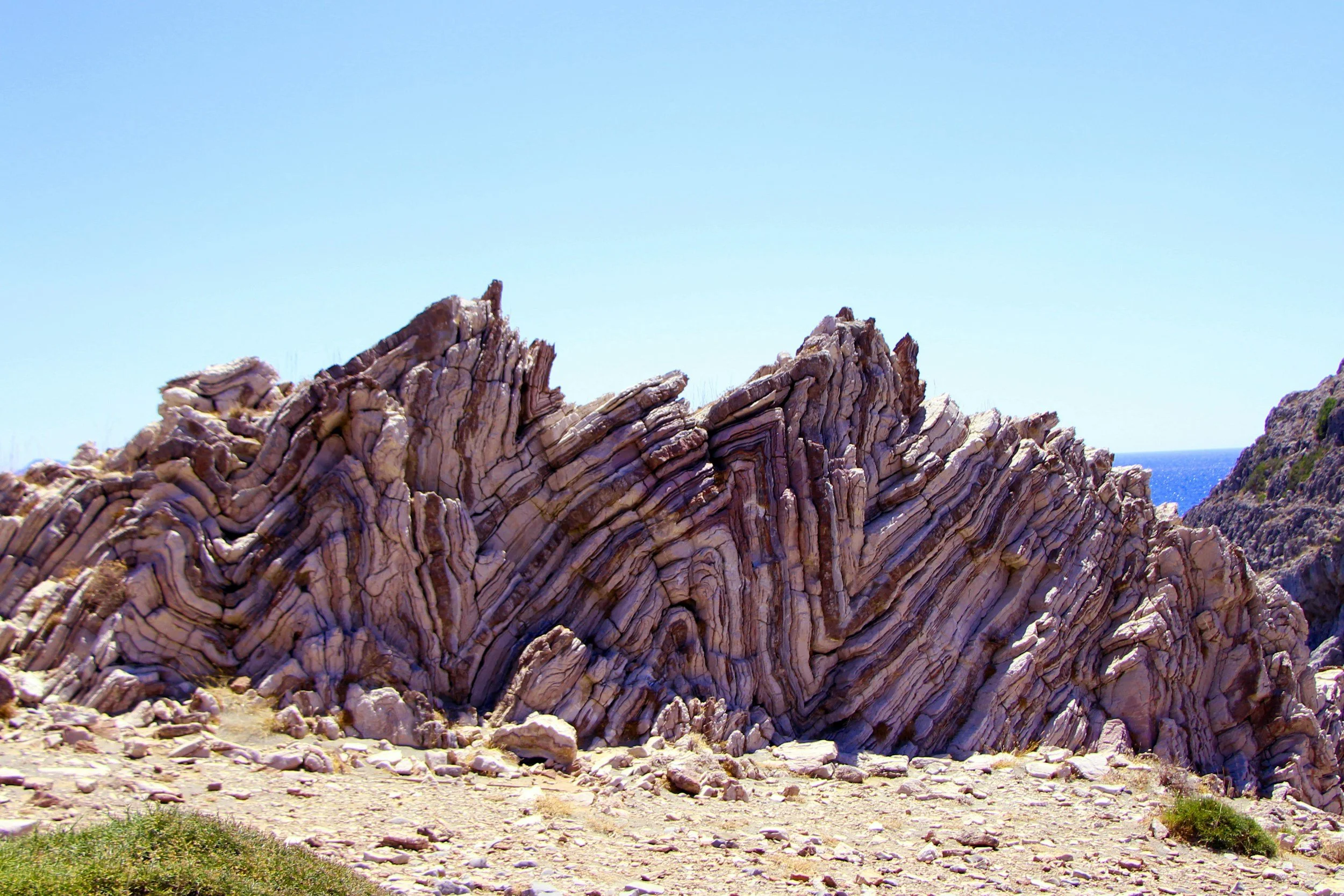
Between the village bay and the great dune beach lies one of the stranger geological formations in Crete, and one of the least known outside the region. The Apoplystra Folds are a series of rock strata that have been compressed, twisted and sculpted over millions of years by the immense tectonic pressures that built this island — the same forces that pushed the White Mountains skyward and folded the gorges of the west into their current shapes. Here, those forces left their mark on the surface rather than the skyline.
The result is a rock face of extraordinary colour and movement. Vivid bands of ochre, cream, rust and deep grey curve through the stone in patterns that look less like natural geology and more like something painted. Layers that were once horizontal have been bent into arcs, some nearly vertical, some folded back on themselves entirely. The colours shift with the light — muted at midday, luminous in the morning and late afternoon when the low sun catches the mineral surfaces at an angle. They have been formally proposed for inclusion in Greece's list of Natural Monuments, and the proposal is long overdue.
You reach the Apoplystra by climbing a wooden staircase from the western end of the Agios Pavlos beach. The walk to the dunes takes ten to fifteen minutes. Most people pass through quickly on their way to the dunes and barely register what they are looking at. Stop. The Apoplystra is worth time on its own terms.
The Dune Beach
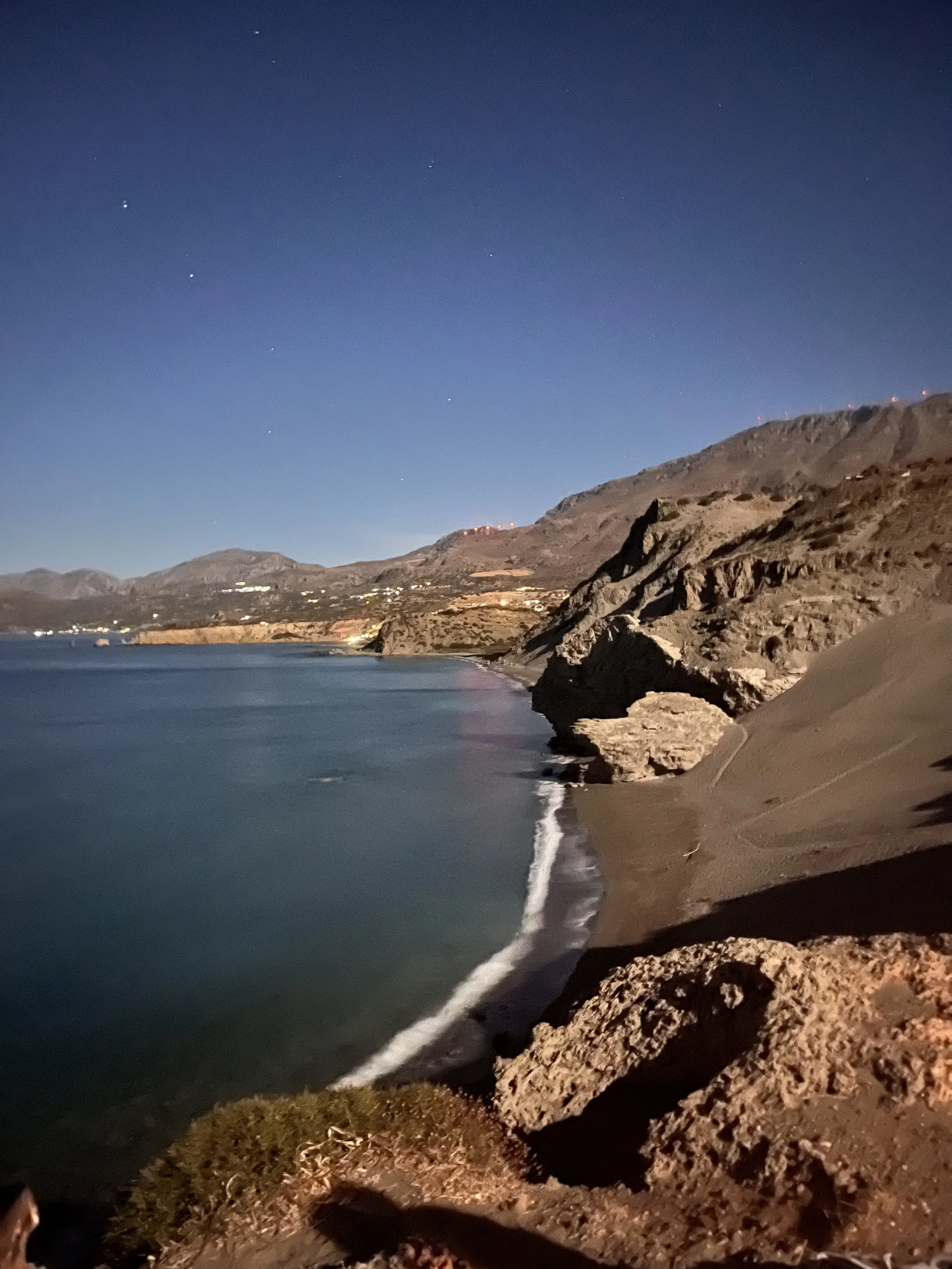
What opens up beyond the Apoplystra is Akoumiani Gialia — also called Alatsogremni, meaning salt cliffs in local usage, or simply the Melissa beach, after the cape that closes it to the south. It is considered by many who know the south coast well to be among the finest beaches in the Rethymno prefecture, and the claim is not excessive. The cape takes its name from the Greek word for bee, though the reason for the association is now unclear
The dunes here are the first surprise. Crete is not a landscape most people associate with dunes — it is rock, limestone, scrub, gorge. But these are genuinely large, the kind that alter your sense of scale when you first come over the ridge and see them. They descend steeply to the waterline, where the Libyan Sea runs deep and clear and, particularly with a western wind, considerably more active than the sheltered bay at Agios Pavlos. This is not always a calm beach. The waves can be substantial — on those days it is spectacular to watch and inadvisable to swim in alone; on calmer days the seabed rewards snorkellers, and the water temperature holds warm well into October and beyond, rarely dropping below 15 degrees even in winter.
The beach itself is large enough that it never truly crowds, even in August. Shade is scarce — a few umbrellas, and the rocky caves that punctuate the middle section of the beach, which provide a natural shelter that umbrellas cannot replicate. The caves are worth knowing about before you arrive. On a hot afternoon, when the dunes are radiating heat and the sun has no intention of relenting, finding one of those recesses in the rock and sitting with your back against the cool stone and the sea in front of you is one of the specific pleasures of this place.
Nudism is common and unremarked upon. The relative seclusion of the beach — the walk from Agios Pavlos, the absence of direct road access — filters the crowd naturally. The people who make it here tend to be the people who suit the place.
One thing worth knowing before you descend the dunes: getting back up is harder than getting down. The sand is loose and deep, the slope steeper than it looks from the waterline, and in the afternoon heat the climb is genuinely taxing. There are two dune beaches along this stretch, and at the first one a rope has been fixed to assist the ascent — use it. It is not there for decoration. At the second beach you are on your own, so pace yourself on the way down if you are planning to walk back to Agios Pavlos rather than retrace through Triopetra.
The Sunset Plateau
Above the dune beach, on the flat rocky surface that sits at the cliff edge above Cape Melissa, is what is probably the finest sunset vantage point on the entire stretch of coast between Agia Galini and Plakias — and given the competition, that is saying something. We also count it among the most instagrammable spots in the region.
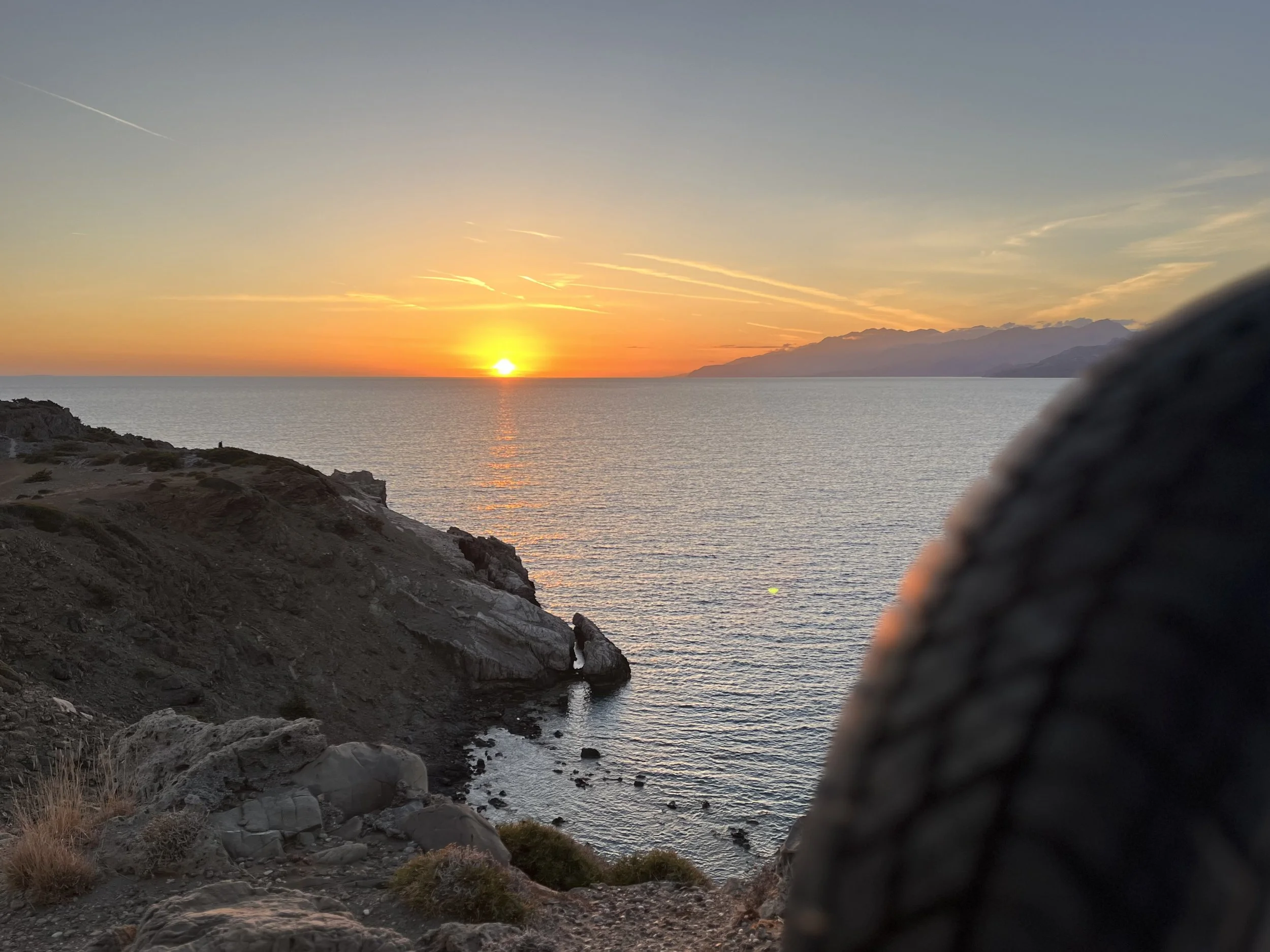
What opens up from that flat platform is a view that takes in Gavdos island in the far distance on clear evenings, the full arc of the White Mountains to the west, and the sweep of the dune beach below. The scale of the view is disorienting in the best possible way — the kind that reminds you how small the roads and the tavernas and the rental cars are in relation to the actual landscape surrounding them.
When the sun goes into the Libyan Sea from here, the sand on the dunes below turns gold. The water holds the colour for longer than seems possible. If you have timed it right and arrived with enough light to find your footing on the walk back, this is one of those evenings in Crete that justifies the entire trip.
Buy a drink from the old man who built a makeshift shack on the plateau and breath it all in.
The Wider Coastline
Agios Pavlos and the Melissa cape sit at the centre of a coastline that rewards exploration in both directions. To the east, between Agios Pavlos and Agia Galini, the road passes through a series of smaller coves and pebbly beaches — Prasonissi, Armenopetra, Agios Georgios — most of them accessible only to those who know to look, most of them empty even in the height of summer. The waters here are calm, the seabed rocky and good for snorkelling, the atmosphere that of places the tourist infrastructure has simply not reached yet.
To the west, Triopetra is a short drive or a longer walk, its three rock formations rising from the sea at the base of Mount Siderotas. The two beaches there — separated by the rocks — have a different character from Agios Pavlos: wider, more open, the western beach in particular exposed to the same Libyan winds that animate the Melissa dunes. Between Agios Pavlos and Triopetra, the Akoumianos river meets the sea at Stomio, forming a natural boundary between the two places and a landscape detail — river mouth, sand bar, the occasional fresh water pushing against the salt — that is quietly unusual for South Crete.
This whole stretch of coast, from Agia Galini west to Plakias, is what South Crete means to people who know it well. Not the famous gorges or the Venetian harbours or the archaeological sites — those belong to the island's other register. This is the quieter one: the one that requires a car and a willingness to follow roads that narrow without warning, and rewards that willingness with beaches and light and an absence of organisation that feels increasingly rare.
Getting There
Agios Pavlos is about 60 kilometres south of Rethymno and is reached via Saktouria or the coastal road from Triopetra or Agia Galini. A car is essential — there is no meaningful public transport.
The dune beach can be approached from either direction: from the Agios Pavlos side via the path behind the western edge of the bay — five to ten minutes on foot, descending a steep sandy slope — or from a dirt road leading towards the plateau just before the start of the village (type “Sand Dune Parking Agios Pavlos” into Google Maps).
Staying in the Area
The triangle formed by Agios Pavlos, Triopetra and Agia Galini is one of the most rewarding bases on the south coast — close enough to each beach to reach them without planning, remote enough to feel genuinely away from things. For guests who want to explore this stretch at their own pace, with the freedom to reach the dunes in the morning and the cliff plateau in the evening, a private villa makes considerably more sense than a room above a taverna.
Eulimene, SeaCrete and Villa Faros are all part of the STAYS Home Collection and sit within easy reach of Agios Pavlos and Cape Melissa. You can explore all three in our Home Collection.
