
The Phaistos Disc: The Most Mysterious Object in Crete
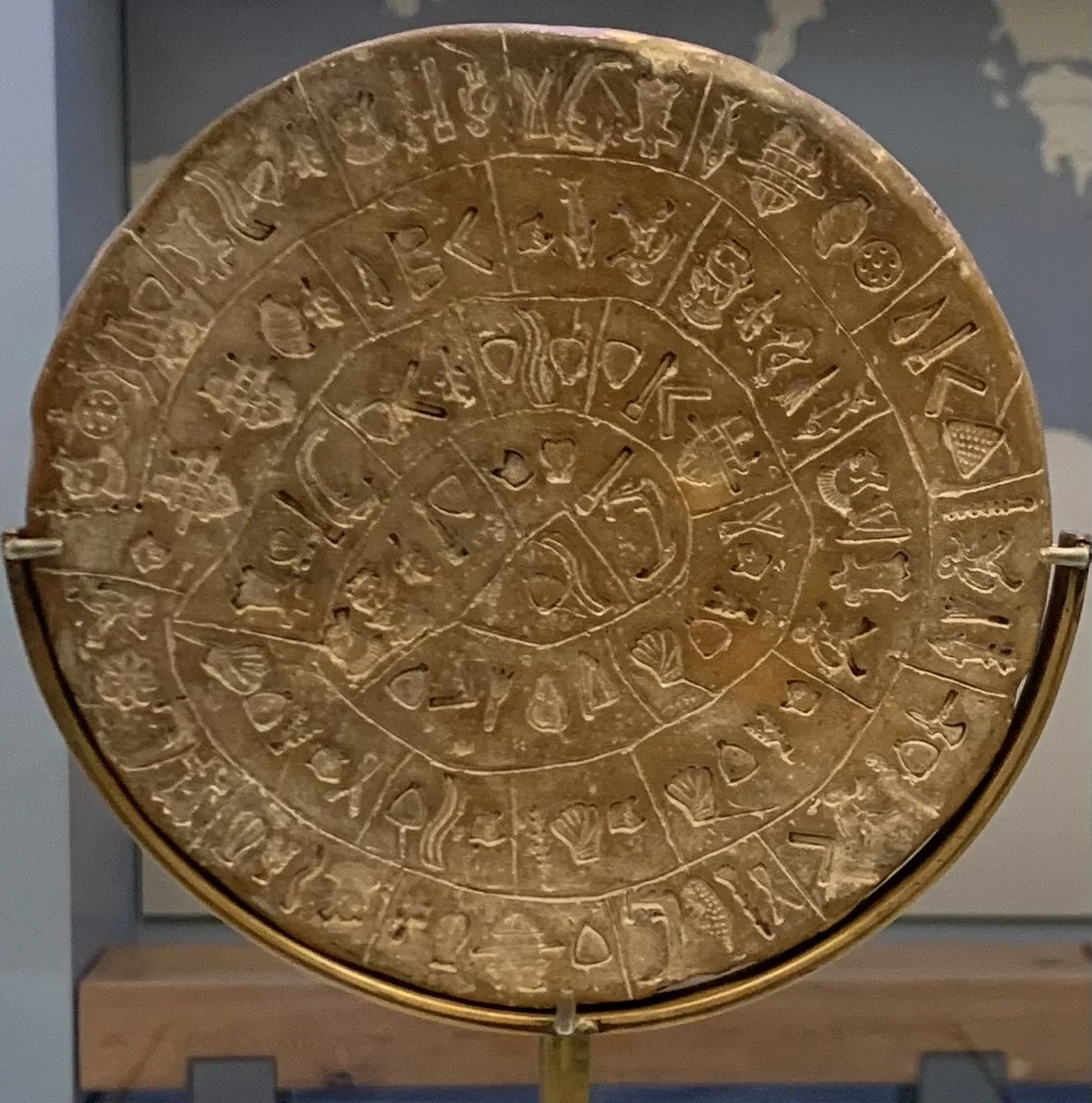
On the evening of 3 July 1908, a craftsman named Zacharias Eliakis interrupted his supervisor's letter-writing with an unusual find. Luigi Pernier, leading the Italian Archaeological Mission at the Minoan palace of Phaistos on the southern coast of Crete, was handed a clay disc still covered in excavation dirt. In the fading light, Pernier could make out what appeared to be writing in an unknown language pressed into both faces of the object. He added a postscript to his letter, describing the find. The disc was about the size of a dinner plate — 16 centimetres across, roughly 2 centimetres thick — made of fine clay, covered on both sides with symbols arranged in a spiral. It had been fired, which was unusual. And it was unlike anything anyone had ever seen.
More than a century later, it still is.
What the Disc Actually Is
The Phaistos Disc is a fired clay tablet bearing 241 symbols, comprising 45 distinct signs, impressed into the wet clay using individual stamps before firing — making it, in effect, the earliest known example of moveable type. The symbols are grouped into 61 clusters, separated by incised lines, and almost certainly represent words or phrases. They are arranged in a spiral on both sides, reading from the outer edge toward the centre. The pictograms are recognisable in form — a helmeted head, a walking figure, a ship, a bird, a beehive, a fish — but their meaning, their language, and even their reading direction remain unresolved.
The disc dates to approximately 1700–1650 BC, placing it in the Middle Minoan period, the height of Minoan palace culture. It was found alongside a Linear A tablet and Kamares ware pottery, both consistent with this dating. Linear A — the Minoan script that preceded the later, partially deciphered Linear B — has itself never been fully decoded, which is part of the problem.
The Forgery Question
Before we reach the decipherment debates, there is a prior question that has shadowed the disc since at least the 1970s: is it real?
In 2008, for the centennial of the discovery, Jerome Eisenberg — an antiquities dealer and editor of Minerva magazine who had built a career exposing fake ancient art — published a detailed argument that the disc was a modern forgery, fabricated by Pernier himself to advance his career. Eisenberg noted that Pernier had been having an unproductive season at Phaistos, while his colleagues Federico Halbherr at Gortyna and Arthur Evans at Knossos were making spectacular finds. The disc, Eisenberg argued, was suspiciously pristine for a 3,600-year-old object. Its sharp edges, uniform firing and the unusually sparse field notes from the day of discovery all pointed, in his view, to a fabrication.
His proposed solution was simple: a thermoluminescence test, which measures the radiation absorbed by fired clay since its last heating, would date the disc definitively. If the firing happened a century ago rather than four millennia ago, the case would be closed.
The Heraklion Archaeological Museum has declined to allow the test.
The museum's position is not without logic — thermoluminescence dating requires drilling into the object, and drilling into one of the most famous artefacts in Greek archaeology is not a decision taken lightly. But as Eisenberg's supporters point out, the refusal has not helped the museum's case.
The mainstream archaeological view, however, does not support the forgery hypothesis. Pavol Hnila, a researcher at the University of Berlin, responded directly to Eisenberg in 2009. Analysing Pernier's personal letters, Hnila argued that Pernier had not behaved like a man concealing a fraud — he was open about the suspicious circumstances of the find, even raising the similarity himself between the disc and the Etruscan disc of Magliano, a comparison that a forger trying to pass the object off as unique would presumably have avoided. More significantly, a clay sealing discovered in 1955, nearly half a century after Pernier's death, bore the only known parallel to sign 21 on the disc — the so-called "comb" sign. This parallel could not have been planted by Pernier, who died in 1937. It is, for most scholars, the most compelling single piece of evidence for authenticity.
The consensus today treats the disc as genuine. But the thermoluminescence test has never been done, and the question has never been formally closed.
The Decipherment Problem
Assuming the disc is authentic, what does it say?
The short answer is: nobody knows, and the situation is more intractable than it first appears. Elizabeth Barber, in her foundational work Archaeological Decipherment published by Princeton University Press in 1974, identified the structural problem with characteristic precision: with only 241 sign-tokens of 45 distinct types, there is insufficient data to either prove or disprove any proposed reading. The corpus is mathematically too small. No future algorithm, no future computational breakthrough, will change this. The data is the data, and there is not enough of it.
This has not stopped people trying.
The most prominent living proponent of decipherment is Gareth Owens, a linguist at the Hellenic Mediterranean University in Crete, who has returned to the disc repeatedly over the past decade. Working from the phonetic values established by Michael Ventris and John Chadwick in their decipherment of Linear B — the Mycenaean Greek script that followed Minoan civilisation — and applying comparative Indo-European linguistics, Owens has argued that the disc is a religious hymn in the Minoan language. Side A, he believes, honours a pregnant goddess; side B, a goddess in the act of giving birth. In 2024, Owens claimed a 99% decipherment.
The reception among specialists has been sceptical. Thomas Palaima, an Indo-European linguist at the University of Texas, and Brent Davis, a Bronze Age art and archaeology scholar, both published detailed critiques of Owens' methodology, arguing that he assigns phonetic values to symbols without demonstrating the underlying phonological system — essentially, that he is reading words without first proving the grammar. Yves Duhoux, the Belgian classicist who wrote the definitive academic overview of decipherment attempts under the damning title How Not to Decipher the Phaistos Disc, has noted that virtually every proposed reading fails the most basic standard of independent verification: given the same symbols and the same method, another scholar arrives at a different result entirely.
Owens is not without academic allies. Anna Sacconi had proposed in the 1990s a broadly similar reading of the disc as a devotional text addressed to a Minoan goddess, drawing on parallels with Linear A religious terminology. And John Coleman, professor of phonetics at Oxford, collaborated with Owens on aspects of the phonetic analysis. But the field's dominant voices remain unconvinced.
The other serious interpretive tradition treats the disc not as phonetic text at all — not a string of sounds representing words — but as a system of symbolic meaning more akin to early Egyptian or Chinese writing, where signs carry semantic rather than phonetic weight. Under this reading, trying to assign syllabic values to the symbols is the wrong approach entirely, which would explain why a century of attempts in that direction has produced nothing that sticks.
There are also less credible theories. The disc has been identified as an astronomical chart, a board game, a prayer wheel, a lunisolar calendar, a Minoan passport, a map of the labyrinth, a message from Atlantis, and — inevitably — an extraterrestrial navigation device. These can be safely set aside.
Why It Matters
The disc is unique in a way that is genuinely troubling for archaeology. Every other undeciphered ancient script — Linear A, Proto-Elamite, the Indus Valley script — exists in large enough quantities that decipherment remains at least theoretically possible given the right breakthrough. The Phaistos Disc exists once. There is no other inscription in the same script anywhere in the world. No bilingual key. No parallel text. No second example against which to test a hypothesis.
This is what separates it from the great decipherment stories of archaeology. Ventris cracked Linear B because there was enough Linear B to work with. The Rosetta Stone gave Champollion Egyptian hieroglyphics alongside Greek he could already read. The Phaistos Disc offers 241 symbols and nothing else.
Linguist Andrew Robinson, who has written extensively on undeciphered scripts, has called for the thermoluminescence test to be done regardless of the museum's reluctance — not to chase a sensational result, but because the authenticity question must be settled before the decipherment question can mean anything. You cannot decode a message if you are not certain it is a message.
The Object Itself
It is worth remembering, amid all this, that the disc is a small, handmade object. Whoever pressed those stamps into the wet clay did so deliberately, one sign at a time, working around a spiral on both sides of a piece of clay they had smoothed by hand rather than shaped in a mould — which is why the disc is not quite perfectly round, and not quite uniformly thick. Its diameter ranges between 158 and 165 millimetres. It sits in Case 41 of the Heraklion Archaeological Museum, where you can stand close enough to see the individual impressions.
The person who made it had a purpose. They arranged 61 groups of symbols across two faces of fired clay, wrapped them in a spiral, and presumably expected someone to read them. Whether that reader was a priest, a merchant, a scribe, or a king; whether the text is sacred or administrative, phonetic or symbolic; whether it was made in Crete or brought from somewhere else — none of this is known.
The disc has been in the museum since 1908. It has outlasted every theory proposed about it. And it will almost certainly outlast the next one too.
Phaistos is less than an hour's drive from our properties in South Crete. If you are planning to visit the palace and the museum in Heraklion, the south coast makes a quiet and well-positioned base. You can explore the Home Collection here.
