
The Palace of Phaistos: The Minoan Site That Knossos Visitors Rarely Find
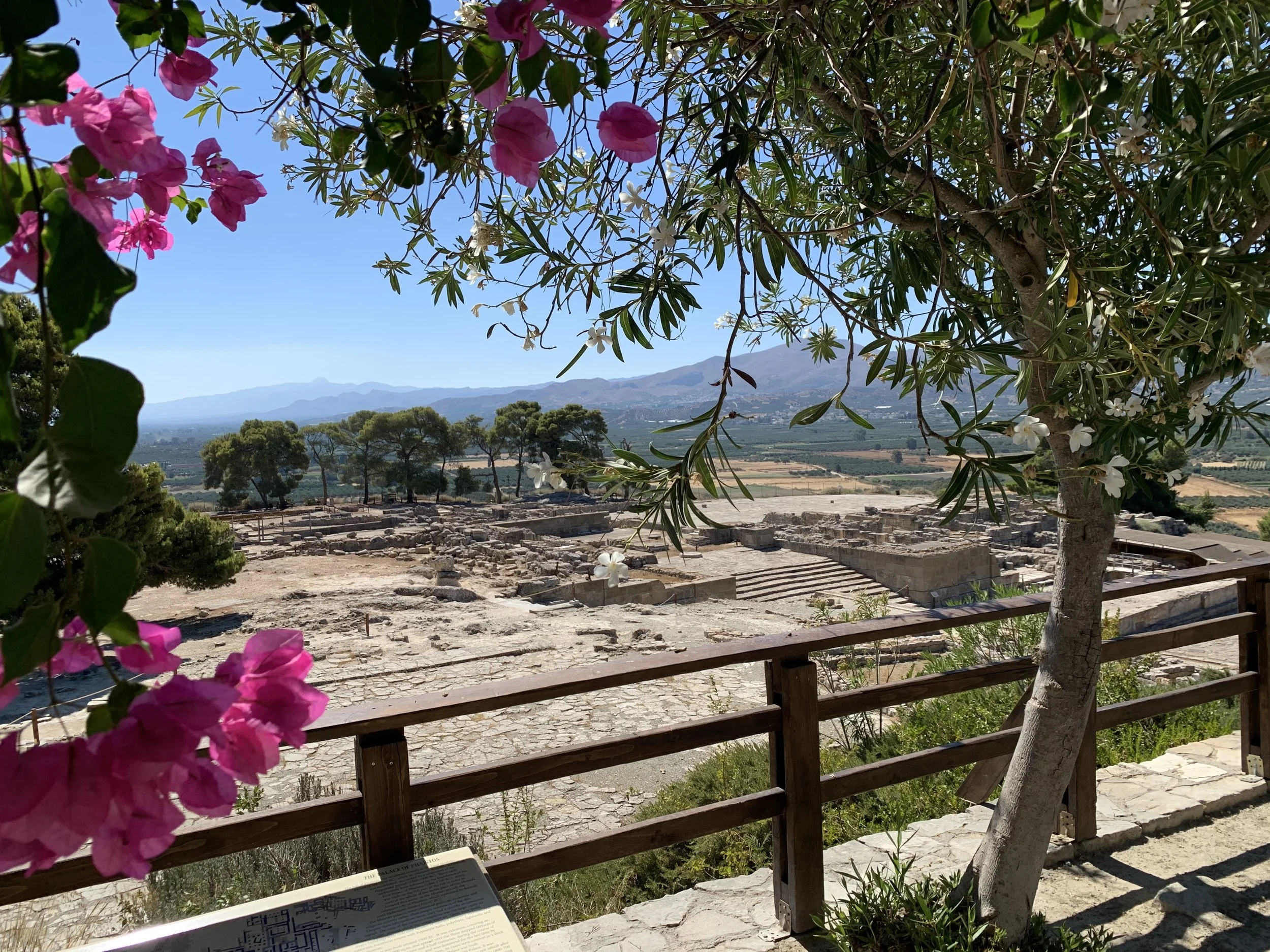
There is a version of a Crete holiday that includes Knossos and nothing else from the island's ancient world. It is understandable — Knossos is famous, it is signposted from the north coast, and the organised tours make it easy. But there is a second Minoan palace on the island that is, in many respects, the more satisfying experience — quieter, better sited, more honest about what it is — and it sits twenty minutes from the south coast.
The Palace of Phaistos is the second largest Minoan palace on Crete. It is less visited than Knossos by a considerable margin. This is, for the visitor, largely good news.
Where it sits
The hill the Minoans chose for Phaistos is one of the finest pieces of real estate in the ancient world.
To the east, the Messara Plain — the largest fertile valley on Crete, where the Minoans grew the grain and olives that funded their civilisation — stretches toward the horizon. To the north, Mount Psiloritis, the highest peak on the island, rises above the plain with its snow-capped summit visible for much of the year. To the south, the Asterousia mountain range runs toward the Libyan Sea, which glitters on clear days from the palace's upper terraces. In antiquity, Phaistos controlled this entire landscape from its hilltop, administered the plain below, and traded through its own port at Kommos, on the Libyan coast a few kilometres away.
The builders of the palace understood what they had. The courtyards, terraces, and stairways are positioned to capture the views rather than enclose against them. Standing in the Central Court on a clear morning, with the plain below and the mountains behind, is to understand something about the Minoans that the objects in Heraklion's museum only partially convey: that these were people with a sophisticated relationship to landscape, who built not just functionally but beautifully, in full awareness of where they were.
In 2025, the Archaeological Site of Phaistos was officially recognised as a UNESCO World Heritage Site — a distinction long overdue.
The history
Settlement on the Phaistos hill dates to the Neolithic period, around 4000 BCE. The first palace was built around 1900 BCE, constructed on embankments that levelled the hilltop and created the platform on which the complex would grow. It was destroyed — almost certainly by earthquake, the same seismic event that damaged palaces across the island — around 1700 BCE.
The second palace, built directly on the ruins of the first, was larger, more refined, and organised around the same basic spatial logic: a large central court flanked by residential, administrative, and storage wings, with a theatrical area in the west court where ceremonies and assemblies took place. This second palace was destroyed in turn, around 1450 BCE, in the island-wide catastrophe — earthquake, volcanic event, or both — that ended the Minoan palatial era. The Mycenaean Greeks who followed left almost no trace at Phaistos. The site was reoccupied in the Geometric period, minted its own coins, built alliances with other Cretan cities, and eventually fell to its neighbour Gortyna around the end of the third century BCE. After that it disappeared from recorded history entirely, its ruins slowly swallowed by the hill.
Excavations began in 1900, the same year Evans started at Knossos, conducted by the Italian Archaeological School under Federico Halbherr and Luigi Pernier — the same Pernier who would find the Phaistos Disc eight years later in a side chamber of the palace, buried in ash. The Italians have continued excavating here ever since. What they chose not to do, unlike Evans at Knossos, was reconstruct.
The Evans difference
This is the most important thing to understand before you visit, and it shapes the experience entirely.
At Knossos, Evans rebuilt — columns in concrete, frescoes repainted from fragments, rooms named and arranged to fit his reading of the myths. The result is a site that is more immediately legible but historically compromised, Evans's imagination intertwined with the Minoan original in ways that subsequent archaeology has spent a century trying to unpick. As we explored in our guide to the Palace of Knossos, the reconstructions tell you as much about 1900 as they do about 1700 BCE.
At Phaistos, nothing has been reconstructed. Only conservation work has been done — stabilising what exists, protecting what survives. What you walk through is what the Minoans actually built. The stone of the Great Staircase is the original stone, worn smooth over three thousand years. The walls of the Central Court are the actual walls. The pithoi — the great storage jars, some still in their original positions in the magazine rooms — were placed there by Minoan hands.
The trade-off is that Phaistos requires more of the imagination. Without reconstructed columns and painted ceilings, the visitor has to work slightly harder to understand what a room once was. But this effort is returned with interest: what you are looking at is real, and the realness of it, once felt, is not easily forgotten.
What to see
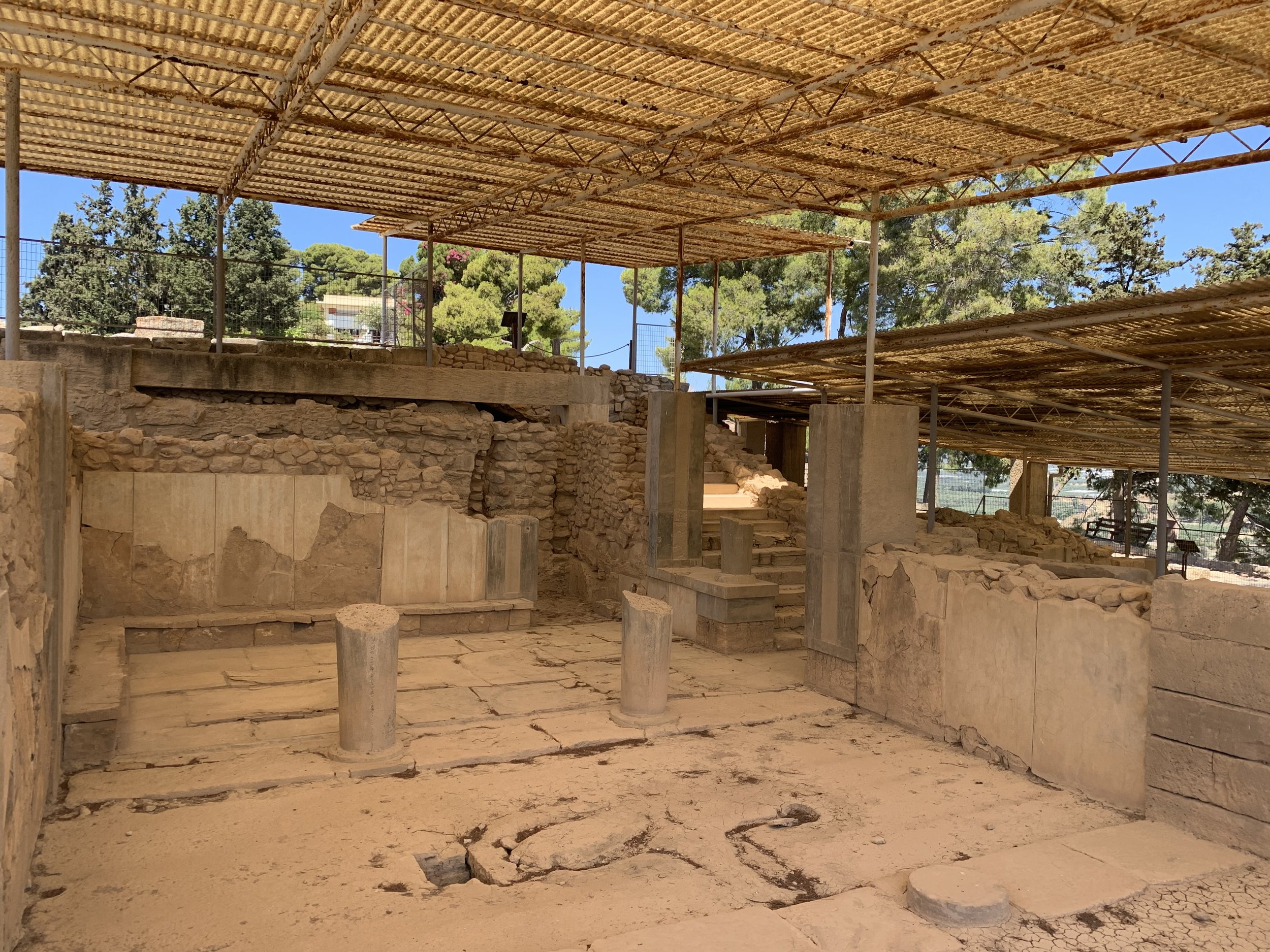
The site is entered from the northwest, through the Upper Court, which offers the first of the views and an immediate sense of the scale of the complex. The West Court below contains the theatral area — nine broad steps where spectators sat or stood for religious ceremonies and assemblies. Unlike the theatrical area at Knossos, which faces the Royal Road, this one looks out over the West Court and the plain beyond. The effect, with the mountains on the horizon, is striking.
The Great Staircase connecting the courts is one of the most impressive architectural elements on the site — wide, formal, built to accommodate processions rather than merely foot traffic. At the top, the Propylaea leads into the Central Court, a large paved space that served as the organisational heart of the palace. The walls that flanked it were multi-storeyed; what remains suggests a building of considerable height and grandeur in its original form.
The royal apartments in the north wing are among the best-preserved areas, with light wells — open shafts designed to bring air and daylight into the interior rooms — still legible in the stonework. The Minoans understood ventilation and the management of heat in ways that would not be standard practice in European architecture for millennia.
The magazine rooms, where storage jars once held grain, oil, and wine for the palace's redistribution economy, retain several pithoi in situ. Their presence gives a concrete sense of how the palace functioned: not simply as a royal residence but as a centre of economic organisation for the entire Messara Plain.
The kouloures — circular pits in the West Court, their purpose still debated — may have held sacred trees, or served as ritual basins. Their presence, without consensus on their function, is a good reminder that Phaistos, like everything Minoan, gives up its meanings reluctantly.
Agia Triada: worth adding
Three kilometres west of Phaistos, at the other end of the same ridge, is Agia Triada — a smaller Minoan site that most visitors overlook and almost always find rewarding.
The site's original name is unknown; the Italians who excavated it in the early twentieth century named it after an abandoned nearby village. What they found was a royal villa, possibly the summer residence of the ruler of Phaistos, that produced some of the finest objects in the Heraklion museum — the Agia Triada Sarcophagus, the Chieftain's Cup, the Boxer Rhyton. The villa itself, though smaller than the palaces, has all the architectural hallmarks of Minoan high culture: light wells, polythyra, storage magazines, frescoed walls. It also produced more frescoes than any other Minoan site on the island.
Agia Triada is rarely busy. On most days, especially outside July and August, it is possible to have the site almost entirely to oneself — a quality that is rarer than it should be in the ancient world, and that the south coast, generally, does better than anywhere else on Crete. A combined ticket covers both Phaistos and Agia Triada. The walk between them, along the ridge with the plain below on one side and the hills on the other, takes about forty minutes and requires no particular equipment.
Kommos: the port that fed the palace
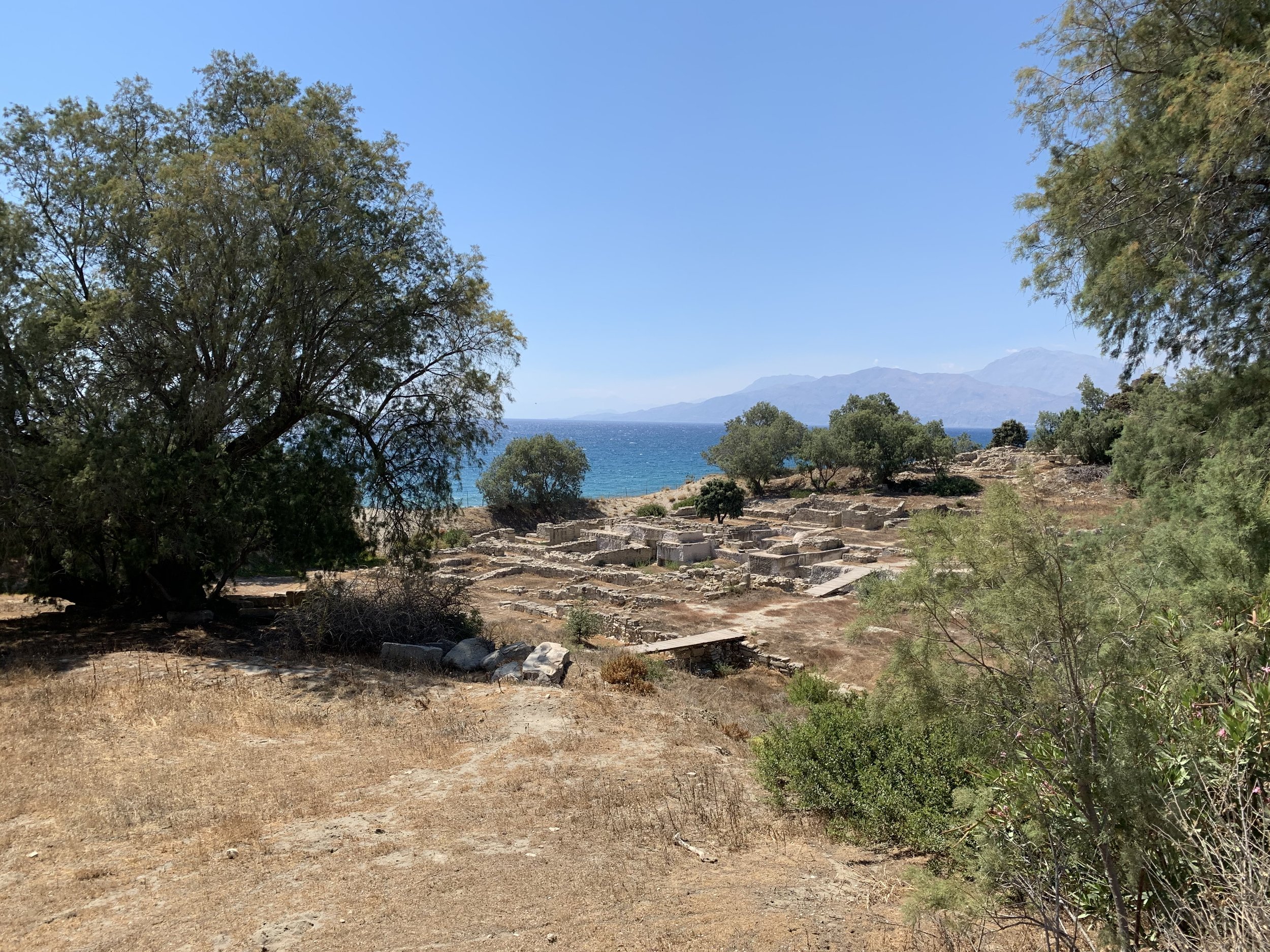
A few kilometres southwest of Phaistos, where the Messara Plain meets the Libyan Sea just north of Matala, lie the remains of Kommos — the ancient harbour that served as Phaistos's window onto the wider Mediterranean world.
Kommos cannot be visited today. The site is under active excavation by a joint Greek-Canadian team and remains closed to the public, which makes it one of the more tantalising invisible presences in the south coast landscape. But it is worth knowing about, because it changes how you read the palace above it.
The Minoans did not build Phaistos in isolation. The palace administered the Messara Plain, yes — its grain, its olives, its livestock — but it also traded. Copper from Cyprus. Tin from the Near East. Ivory and exotic goods from Egypt and beyond. All of this passed through Kommos, a harbour large enough to accommodate international shipping from across the Bronze Age Mediterranean world. When you stand in the Central Court at Phaistos and look south toward the Asterousia mountains, the Libyan Sea is somewhere beyond them, and Kommos is at its edge. The palace and the port were a single economic system. What made Phaistos wealthy and powerful came through that harbour.
Excavations at Kommos have revealed a substantial settlement with storehouses, a late Minoan temple, and evidence of sustained contact with Egypt, Cyprus, and the Levant over many centuries. The site continued to be used well into the Iron Age and eventually into the Classical period, long after the Minoan palatial system had ended. The beach at Matala, minutes away and easily visited, occupies the same stretch of coastline. The connection is not invisible so much as unmarked.
Making a day of it
Phaistos sits in the middle of one of the most historically dense corners of Crete. Agia Triada, three kilometres west, extends the morning naturally — see the section above for what to look for there. Gortyna, fifteen minutes east, contains the Gortyn Code: the oldest and most complete example of ancient Greek law, inscribed in stone in the fifth century BCE, still standing in the open air beside a basilica. It is one of those sites that takes twenty minutes to visit and stays with you for considerably longer.
Matala, the beach village with its famous cliff caves, is twenty minutes to the southwest. In the 1970s it became a gathering point for counterculture travellers from across Europe; Joni Mitchell spent time here and wrote about it. The caves, carved into the red cliffs above the beach, are now a protected archaeological site. The town has evolved since without entirely losing its character, and the beach itself is one of the better ones in the Messara area.
From the south coast — Agia Galini is twenty minutes away, Agios Pavlos and Triopetra not much further — Phaistos makes a natural morning excursion: arrive at opening time, walk the site before the heat builds, add Agia Triada on the way back, and be on the beach by early afternoon.
If you are planning to combine Phaistos with the Heraklion Archaeological Museum — where the Phaistos Disc and the objects from Agia Triada are displayed, and where the full picture of what this region produced becomes clear — our guide to the museum covers what to see and why the two visits make each other considerably richer. And for those who want to go further into the ancient landscape of the south coast — the forgotten harbour settlements, the mountain refuge sites, the quieter Minoan traces along the Libyan Sea coast — the STAYS Journal's piece on the hidden archaeology of South Crete, following the work of archaeologist Sinclair Hood, is the natural next read.
For how to structure a week that includes the ancient sites alongside the coast, see our practical guide to how many days you need in Crete. And if you are still choosing where to base yourself, our Home Collection includes villas across the south coast, each within easy reach of Phaistos, Agia Triada, Gortyna, and the Libyan Sea.
The Minoans built Phaistos to last. It has outlasted the earthquakes, the Mycenaeans, the Gortynians, and two thousand years of anonymity. It deserves at least a morning of yours.
