
The Archaeological Museum of Heraklion: A Portal into the World of the Minoans
There is a reasonable argument that the Archaeological Museum of Heraklion is the most important museum you have never heard of.
Most people who come to Crete have Knossos on their list. Fewer think to add the museum. This is a mistake — and in some respects it is the wrong order. The museum is where the palace makes sense. The frescoes Evans excavated and partially invented are here in their original form, corrected and contextualised by a century of subsequent scholarship. The jewellery, the pottery, the ritual objects, the burial goods — everything that Knossos once contained, and that the ground around it once held, has found its way here. Standing in this building for two hours will teach you more about the Minoans than a week of reading, or a visit to Knossos, for that matter.
Together with the Acropolis Museum in Athens, the Archaeological Museum of Heraklion ranks among the foremost museums in Europe. For the study of Minoan civilisation specifically, it is simply the best in the world.
The building itself
The museum occupies a modernist building constructed in the 1930s, renovated extensively in recent decades, and recognised with a Bauhaus commendation for its architecture. The two-storey revamped building makes a gleaming showcase for artefacts spanning 5,500 years, from Neolithic to Roman times. Twenty-seven galleries unfold in broadly chronological order, beginning with the earliest traces of human settlement on the island and progressing through the various phases of Minoan civilisation — its development, its artistic peaks, its decline — before moving into the post-Minoan periods. The layout rewards a methodical approach, but even a selective visit, focused on the Minoan galleries, is time well spent.
The frescoes: Evans corrected
The frescoes are where many visitors spend longest, and rightly so. The originals removed from Knossos are here — which means they can be compared against the reconstructions Evans installed at the palace site, a comparison that is devastating.
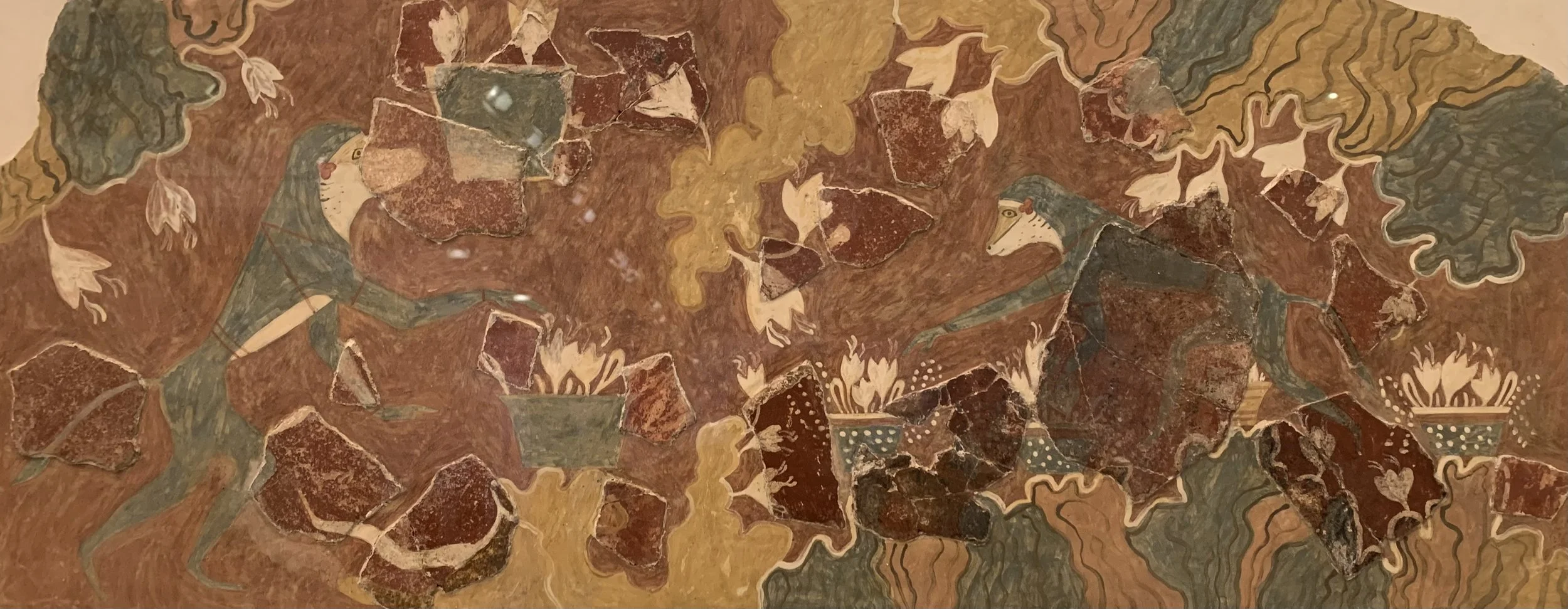
Take the fresco Evans named the "Saffron Gatherer." He reconstructed it as a boy, painted blue in the Minoan fashion, gathering saffron flowers. Later research established that the figure was not a boy at all but a blue monkey — an animal the Minoans appear to have known well through trade with North Africa and Egypt. The museum displays Evans's reconstruction alongside the properly restored original. Side by side, they tell two stories: one about the Minoans, and one about the assumptions an archaeologist brings to the ground.
This is what the museum does at its best. It is not merely a collection of beautiful objects. It is a corrective — a place where the Minoans are allowed, gradually and carefully, to speak for themselves rather than through the expectations of the people who dug them up.
The bull-leaping fresco — young figures, male and female, vaulting over the back of a charging bull — is perhaps the most reproduced image in Minoan art. In reproduction it reads as decorative. In person, at scale, it is something else: athletic, precise, charged with a kind of controlled danger. It tells you something about a culture that chose this image, repeatedly, as a subject for its most significant spaces. The bull appears everywhere in the collection — on drinking vessels, on ritual objects, on architectural decorations. It is not difficult to understand how a civilisation this preoccupied with the animal eventually gave the wider world the myth of the Minotaur.
The Malia Pendant
If the frescoes demonstrate the scale of Minoan artistic ambition, the jewellery demonstrates its precision.
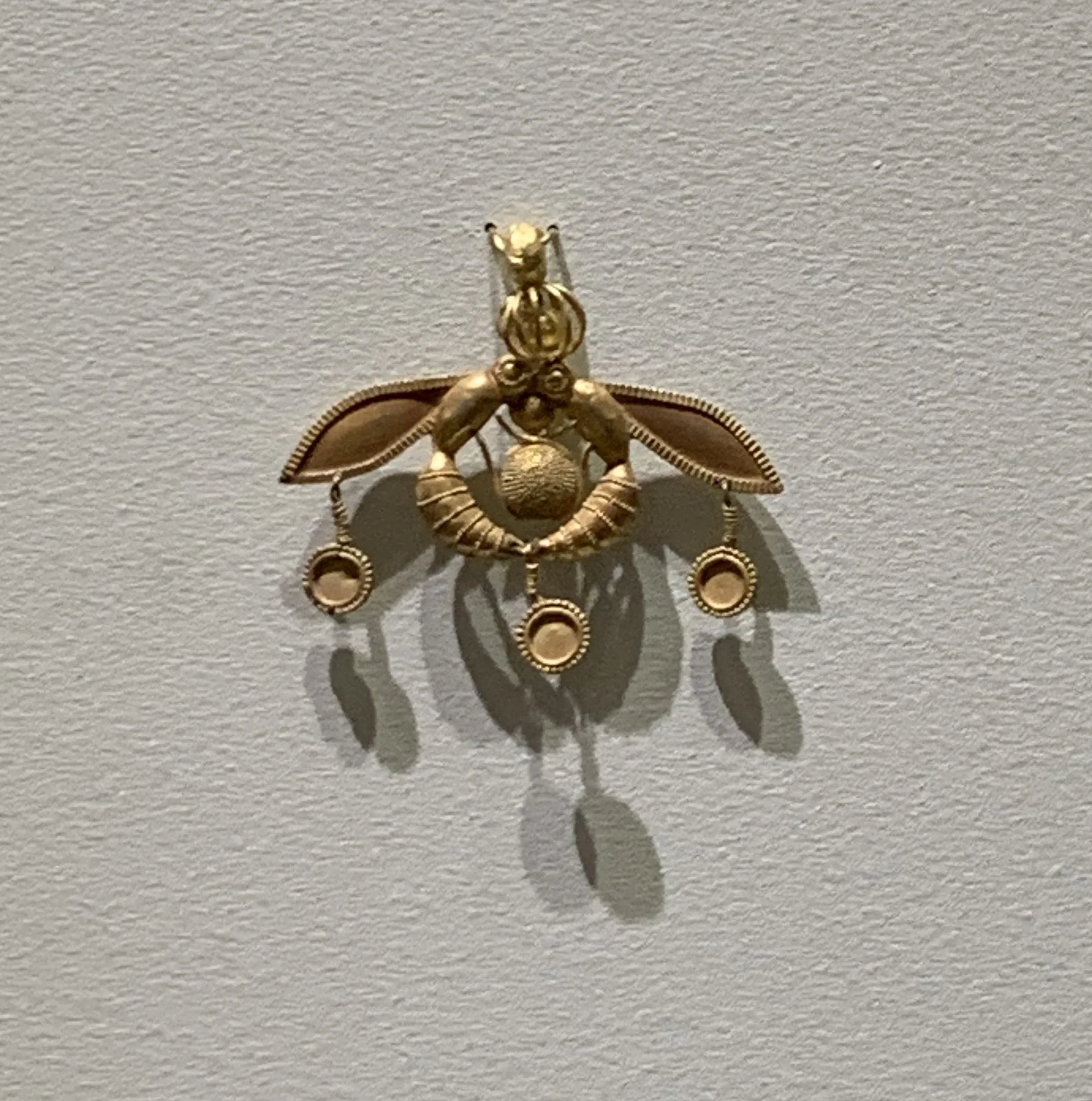
The Malia Pendant — a small gold pendant found at the Minoan cemetery near Malia on the north coast — depicts two bees in perfect mirror symmetry, wings spread, both consuming honey from a shared comb. The arrangement is so formally exact, the execution so delicate, that it would not look out of place in a contemporary jeweller's collection. It was made somewhere between 3,500 and 4,000 years ago. The goldsmith who made it was working at a level of technical mastery and aesthetic confidence that modern craftspeople still find arresting.
What makes the pendant more than a beautiful object is what it implies about the society that produced it. Art of this quality — art with no practical function, created purely to be worn and admired — requires surplus, stability, and a culture that has decided some of its members should spend their time making things of beauty rather than securing survival. The Minoans, at their height, were prosperous enough, organised enough, and peaceful enough to sustain exactly that. The pendant is not just jewellery. It is evidence.
In a room of its own, behind glass, is the object that has consumed more scholarly energy per square centimetre than almost any other artefact in the ancient world.
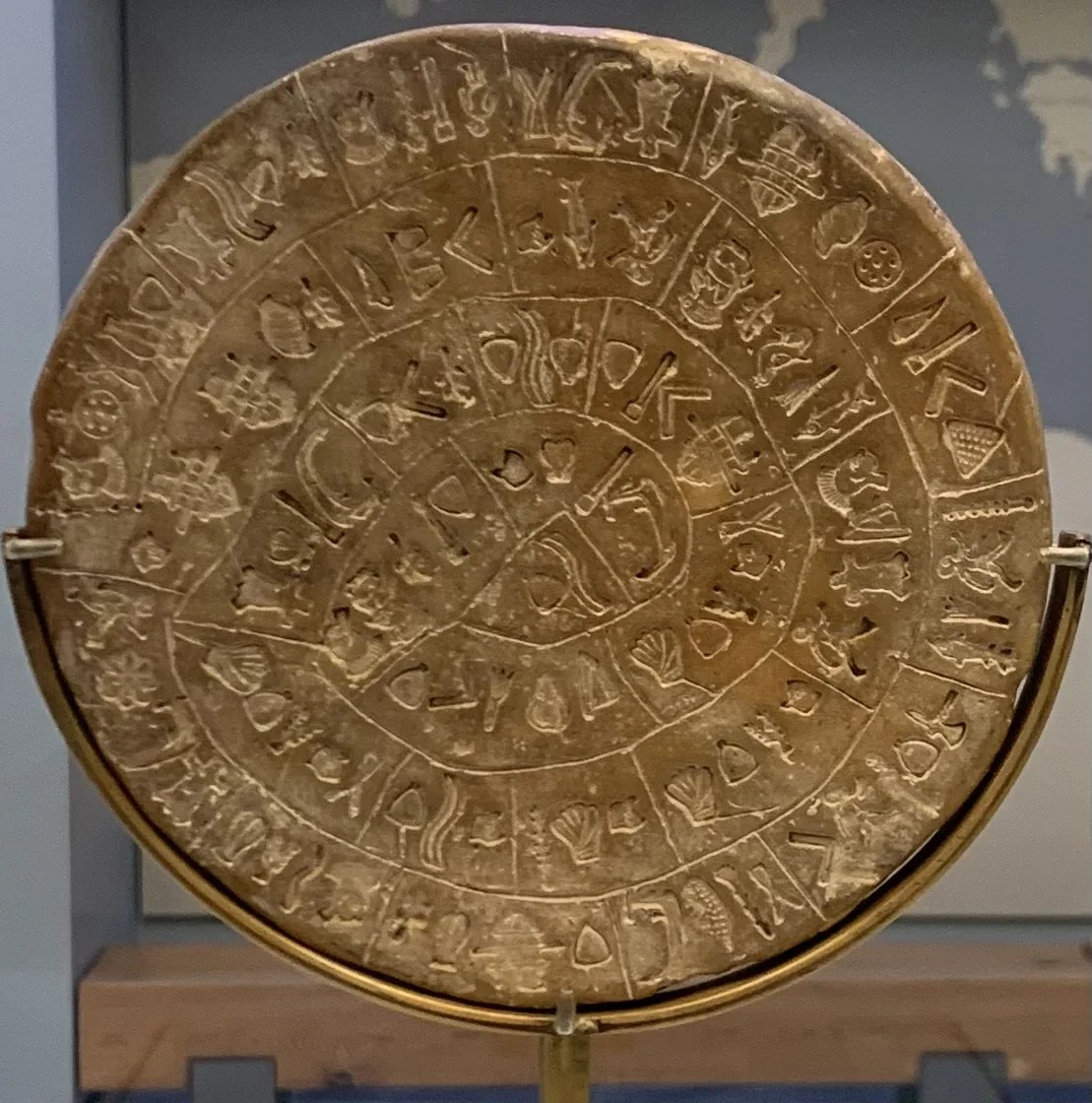
The Phaistos Disc is one of the most iconic yet enigmatic artefacts of the Minoan civilisation. Discovered by Italian archaeologist Luigi Pernier in a room of the Palace of Phaistos on 3 July 1908, it is a clay disc with inscriptions arranged in a spiral pattern. Both sides of the disc were impressed with tiny seals, bearing 241 signs in total, before firing, while the clay was still wet. The signs — depicting people, birds, plants, tools, ships — are arranged in 61 groups, separated by incised lines, presumably representing words. They read from the outside edge spiralling inward.
What the disc says, nobody knows. Despite over a century of scholarly study, its purpose and meaning remain a mystery, fuelling debate and fascination among linguists, historians, and enthusiasts worldwide. The script it uses appears nowhere else in the archaeological record — not in Linear A, not in Linear B, not in any other known writing system. Whether it represents a Minoan religious text, an administrative record, a hymn, military instructions, or something else entirely remains genuinely open. Scholars have proposed early Greek, Luwian, Hittite, Etruscan, and several languages that exist in no other source. None of these proposals has achieved any consensus.
What is agreed upon is the sophistication of the object's manufacture. The 241 individual symbols were stamped into the wet clay rather than carved, leading some researchers to suggest that this may represent the earliest known example of movable type printing — a technology most people associate with Gutenberg, who came roughly 3,400 years later. Whether or not that interpretation holds, the disc was made by people who had thought carefully about how to make it efficiently, which is itself remarkable.
The disc was found at Phaistos — the great Minoan palace above the Messara Plain in the south of the island, twenty minutes from Agia Galini and well worth a visit in its own right. It arrived here, and here it has stayed, still refusing to give up whatever it has to say.
The Arkalochori Axe and the snake goddesses
Among the other highlights: the Arkalochori Axe, a ceremonial object forged from solid gold and engraved with Minoan iconography, found in a sacred cave near the village of Arkalochori. Gold axes of this kind appear to have had a ritual significance — offerings to a deity, perhaps, or objects used in ceremonies whose exact nature remains unclear. The craftsmanship is extraordinary.
The snake goddesses — or possibly priestesses — found at Knossos are among the most recognisable images in Minoan art: female figures holding snakes in both hands, their eyes wide, their dress formal and elaborate. They stand in the museum with an authority that crosses the millennia. Whatever they represent — and the debate continues — they make the centrality of female figures in Minoan religious life viscerally apparent in a way that no academic argument quite manages.
The Agia Triada Sarcophagus, painted with funerary scenes from around the fourteenth century BCE, offers something different again: a rare window into Minoan beliefs about death, the afterlife, and the rituals that attended the journey between them. It is haunting in the way that objects made for the dead often are — a civilisation trying, in paint on clay, to say something to whatever came next.
Evans corrected.
The collection as a whole
The museum's collections, especially the marine-themed pottery decorated with octopuses, shells, and seaweed, and the evidence of extensive trade — imports of copper, tin, ivory, and exotic goods, exports of olive oil, wine, and finished crafts — highlight the Minoans as a thalassocracy: a maritime power. They were master sailors and traders with networks across the Aegean, the Near East, and Egypt. The blue monkey in the saffron-gatherer fresco is one trace of that reach. The ivory, the ostrich eggs converted into ritual vessels, the Egyptian-influenced motifs on Minoan seal stones — these are others. The Minoans were not an island unto themselves. They were connected, cosmopolitan, and aware of the wider world in ways that their remoteness from the modern tourist trail might not suggest.
What the collection asks of you, in the end, is the same thing Knossos asks: that you sit with the gap between what is known and what remains mysterious. We have the objects. We have the buildings. We have the art, the tools, the burial goods, the trade evidence, the frescoes of young people leaping over bulls. We do not have the language. We do not have the texts. We do not, quite, have the people.
The museum brings you closer than anywhere else. It is a portal into ancient Crete, as a visit to Knossos on its own never quite manages to be.
Practical information
The museum is located in central Heraklion, a short walk from the old harbour. From the south coast, allow roughly ninety minutes driving time each way. A combined ticket covers both the museum and the Palace of Knossos, which makes sense to do on the same day if your energy holds — museum first, to provide context, then Knossos in the afternoon. The museum is open year-round; mornings in high season fill quickly with tour groups, so arriving early or late in the afternoon gives you the galleries in closer to the quiet they deserve.
If you are basing yourself on the south coast — closer, quieter, and within reach of Phaistos — our guide to where to stay in South Crete covers the main areas. For how to structure the wider week, including how to balance cultural days with the beaches, see our practical guide to how many days you need in Crete. And if you haven't read our companion piece on whether Knossos itself is worth visiting, that is the natural next stop — the two visits make each other considerably richer.
The STAYS Home Collection includes villas across the south coast, each a comfortable day trip from Heraklion. Phaistos, the southern counterpart to Knossos and the site where the disc was found, is twenty minutes away by car. It appears in its own piece in the Journal shortly.
