
Samaria Gorge: What the Hike Actually Feels Like
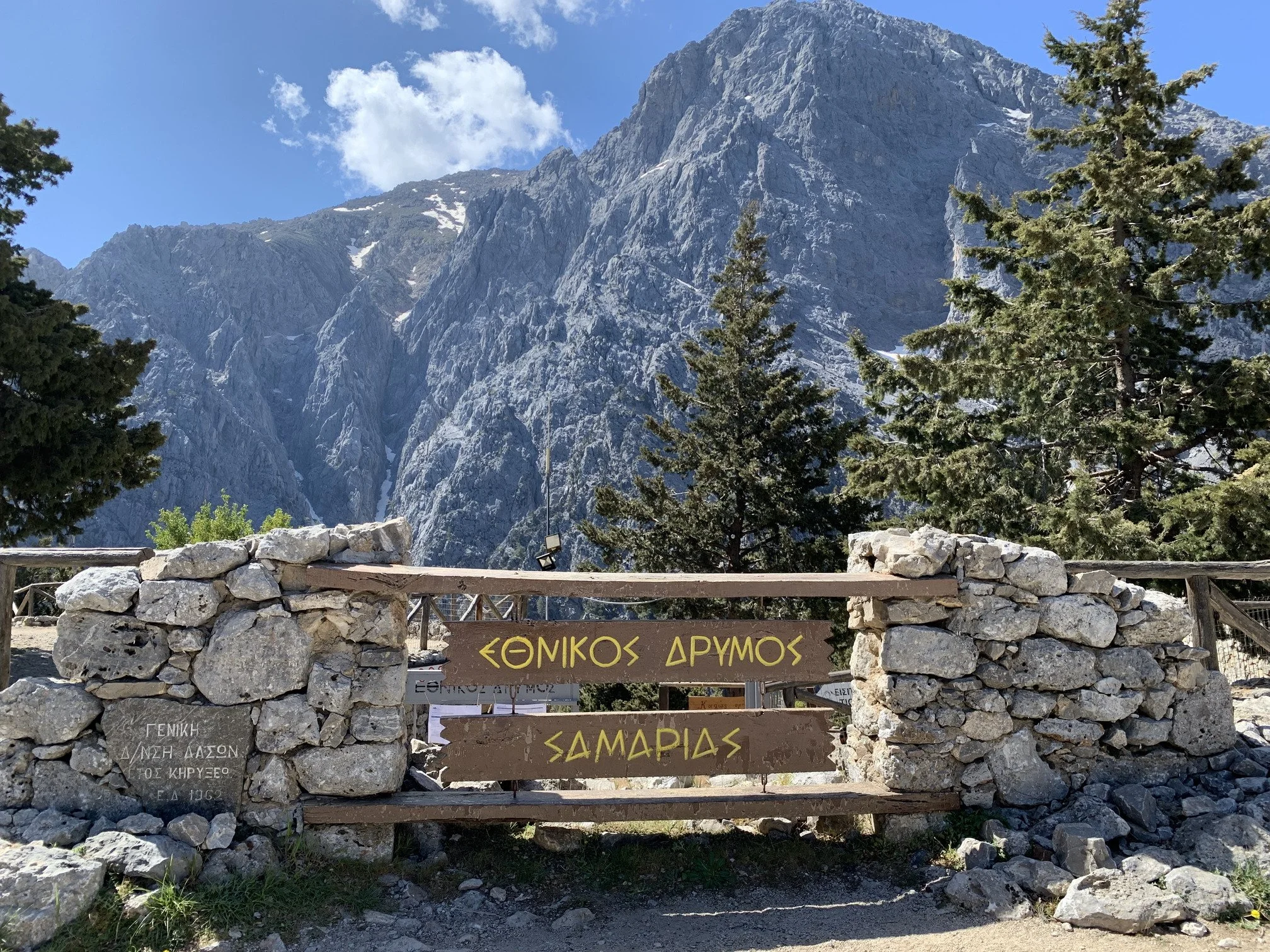
The bus from Chania leaves before dawn. By the time it reaches the plateau of Omalos, the sun is just beginning to catch the peaks of the White Mountains, and the air at 1,200 metres above sea level is cold enough to make you glad you brought a layer. Below, invisible from the road, the gorge is waiting.
The Samaria Gorge cuts through the Lefka Ori — the White Mountains of western Crete — for roughly sixteen kilometres, from the plateau above to the Libyan Sea below. It is one of the longest gorges in Europe, a National Park since 1962, and the single most visited natural site on the island. None of those facts quite prepares you for what it looks like when the path begins to descend and the walls close in around you.
This is not a gentle nature walk. It is also not a technical mountaineering challenge. It is something in between — a long, demanding, genuinely spectacular hike through a landscape that shifts character every hour and that ends, after six to eight hours on your feet, with the Libyan Sea opening in front of you and a cold drink in your hand. Most people who do it say it was the best day of their trip. A few say it was the hardest. Almost nobody says it wasn't worth it.
The landscape and what lives in it
The gorge descends through three distinct ecosystems, visible as you walk.
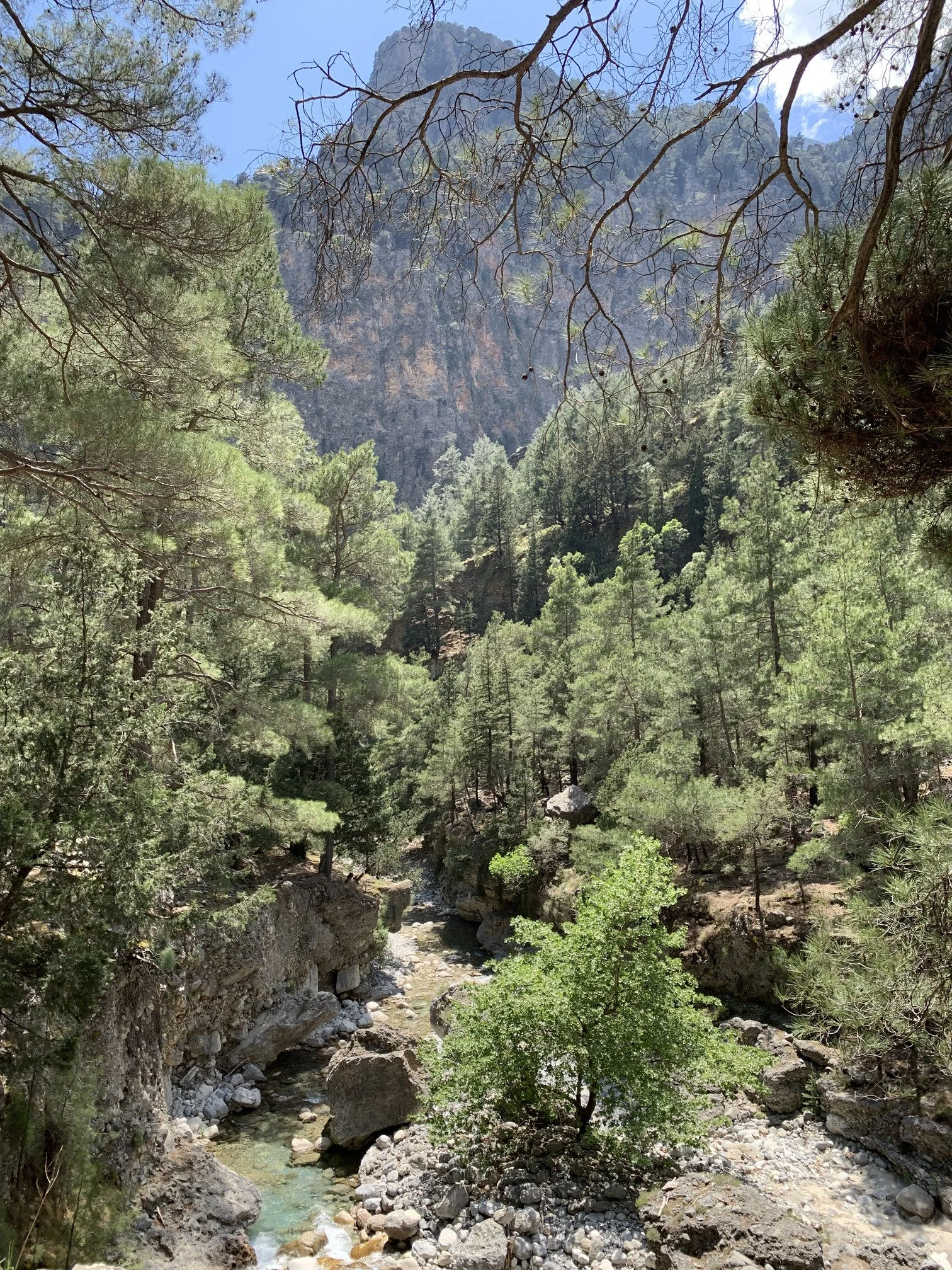
The upper section, immediately below Omalos, is forested — Cretan pine and cypress growing on slopes cool enough to sustain them, the air carrying the particular resinous smell of a Mediterranean mountain forest in the early morning. Light falls at angles through the canopy. At this altitude, the gorge is wide and the walking relatively easy, the path descending at a manageable gradient through shade.
As the altitude drops and the walls begin to rise, the vegetation changes. The pine gives way to plane trees and the endemic Cretan maple, growing in the wet zones along the stream that runs through the gorge floor. Mountain springs emerge from the rock at intervals — the water is clean and cold, and filling your bottle here rather than rationing what you carried is one of the pleasures the gorge provides. The air is cool even in midsummer, the walls tall enough to block the direct sun for much of the morning.
The lower section, in the last few kilometres before Agia Roumeli, is different again: drier, more exposed, the vegetation sparser and the heat more present. This is where fatigue accumulates. The landscape here is beautiful in a starker way than the forested upper gorge — ochre and grey rock, the Libyan Sea glimpsed ahead — but it is also the section where the distance between where you are and where you need to be becomes most tangible.
Throughout all of it, if you are quiet and patient, the kri-kri appears. The Cretan wild goat — an endemic species found nowhere else in the world, with long curved horns and a coat that changes from cream in winter to tawny brown in summer — lives in the gorge and on the surrounding crags. They are not shy exactly, but they are not domesticated either. A kri-kri spotted on a ledge above the path, watching you pass with the detachment of something that has been here considerably longer than you have, is one of those moments that stays with you after the hike itself has faded into a general memory of rocks and sore feet.
Our guide to wildlife in Crete covers the kri-kri and the island's other endemic species in more detail, along with the birds of prey that circle the gorge walls above you.
The Iron Gates
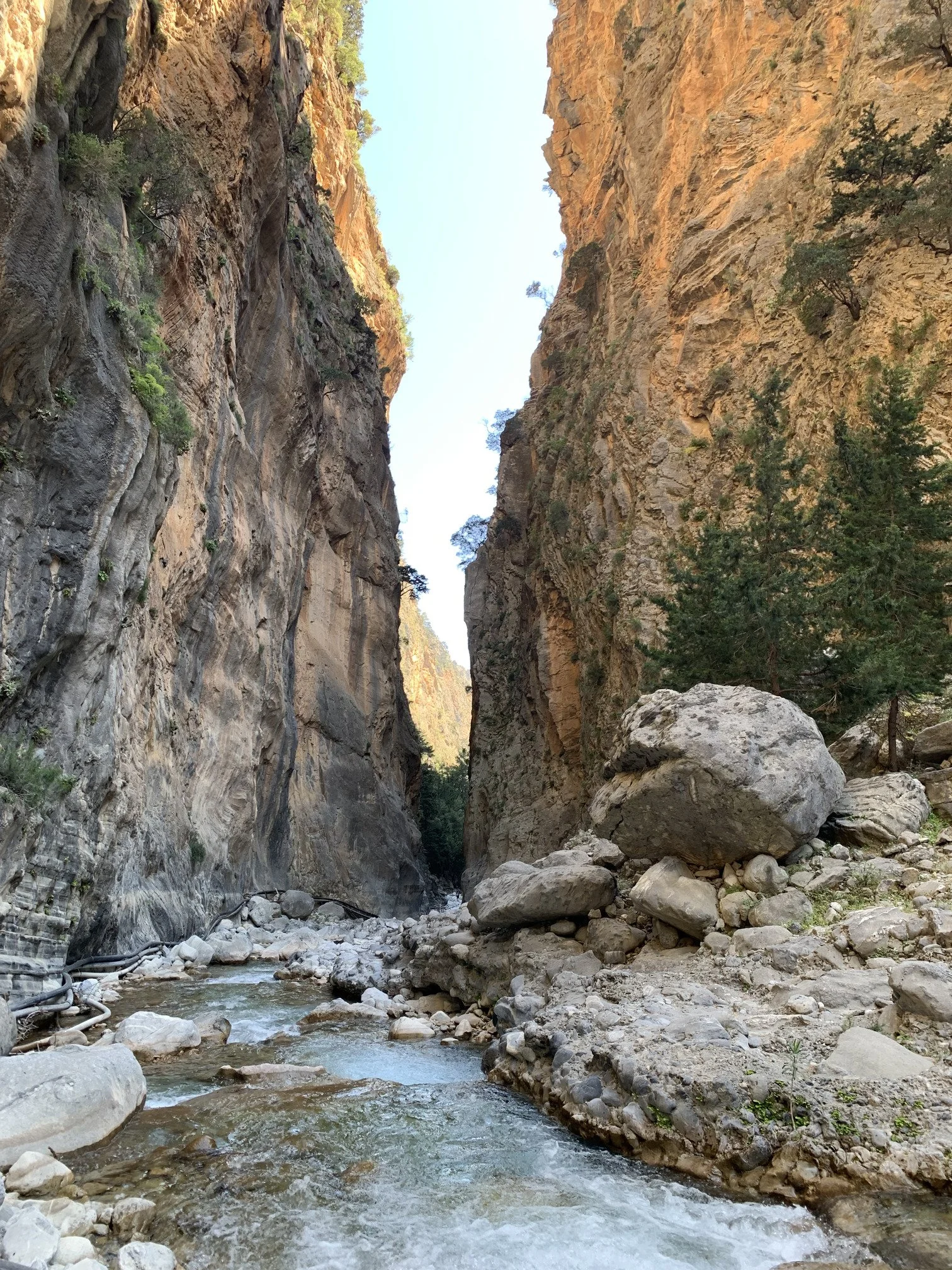
At the narrowest point of the gorge, roughly halfway through, the walls close to less than four metres apart and rise three hundred metres above your head. This is the Sideroportes — the Iron Gates.
The effect is difficult to describe to someone who hasn't stood there. It is not frightening, exactly, but it is vertiginous in a way that has nothing to do with height. The scale of the rock, the narrowness of the passage, the sound of the stream echoing off the walls, the sudden reduction of the sky to a thin strip of blue high above — all of it combines into something that is simply unlike anywhere else. Photographs exist of the Iron Gates. None of them do it justice.
People stop here. They stand in the passage and look up and don't say much. That is the correct response.
What you need to know before you go
The gorge is open from May through October and closed in winter, when flash floods make it impassable and dangerous. The official entrance is at Xyloskalo on the Omalos plateau; the exit is at Agia Roumeli on the Libyan Sea coast, from where a boat takes you to Sougia or Hora Sfakion, then a bus or taxi back to your base. The logistics require some planning, and the sequence — entrance ticket, boat ticket from Agia Roumeli, return transport — is worth sorting before the day rather than improvising at the end of a long walk.
The distance is sixteen kilometres in total, though most of the energy goes into the first thirteen through the gorge itself. The final three kilometres to Agia Roumeli, after the gorge officially ends, are flat and exposed and — having already walked thirteen kilometres — feel longer than they are. Allow six to eight hours in total, more if you move slowly or stop often.
Proper footwear is not a suggestion. The path is rocky and uneven throughout, and the descents in the upper section are steep enough that inadequate shoes create genuine risk of ankle injury. Hiking boots or trail shoes with ankle support are what the terrain demands. The gorge sees visitors every summer who attempt it in sandals; the gorge wins every time.
Water is available at the mountain springs throughout the route, but the spacing between them varies and the lower section has fewer. Carry at least a litre and refill at every spring you pass. Food and sunscreen for the exposed sections. A light layer for the cold of the early morning at Omalos, which you will likely remove by the time you reach the first spring.
The gorge has rangers at intervals who can assist in emergencies, and mule transport is available for those who cannot continue on foot. A first aid station exists approximately halfway. The terrain is wild enough that help takes time — not because the gorge is particularly dangerous, but because it is remote and long and the difference between a good experience and a difficult one is largely determined by preparation and pacing.
Pace, more than anything, is what determines the day. The Samaria Gorge rewards those who move slowly. There is too much to look at — the walls, the water, the light on the rock, the kri-kri on the ledge above — to hurry through it.
Getting there
Most visitors approach Samaria as a day trip from the north coast — typically from Chania, with an early bus to Omalos. This works, and the organised tour option (which handles all the transport logistics in both directions) is sensible if you don't have a hire car and prefer not to coordinate the boat and bus connections independently.
From the south coast, the approach is different. The exit at Agia Roumeli lands you on the Libyan Sea side, where the boats run to Sougia and Hora Sfakion — both stopping points on the south coast route back toward Plakias, Agia Galini, or the wider Rethymno area (although, if you parked your car up at Omalos, there is now way around driving back via Chania).
The south coast also places you closer to other gorges and wild landscapes that share the character of Samaria without its crowds. The Kourtaliotiko gorge near Plakias — covered in our guide to the Kourtaliotiko and Preveli Beach — is shorter, quieter, and ends at the palm forest of Preveli rather than a tourist harbour. Agiofarago, reachable from the south coast by boat or a walk through a canyon, is more remote still.
A word about crowds
Samaria is the most visited natural site in Crete, and in July and August that is visible. The gorge is long enough that the crowd disperses quickly after the entrance, and the Iron Gates never feel like a queue — but the early sections can be busy, and the boat from Agia Roumeli fills up. Going early in the season (May or early June) or later (September, October) makes a significant difference. Starting at the absolute opening of the entrance gate makes another. The people who arrive first have the upper gorge largely to themselves.
It remains, even in high season, one of those places where the landscape is simply too large and too serious to be diminished by the number of people in it.
The moment at the end
There is a moment — and almost everyone who has done this walk describes a version of it — that happens somewhere in the last kilometre before Agia Roumeli. The gorge has been closing in for hours, the walls your constant company, the sky a narrow strip above. And then the walls fall away and the path opens and the Libyan Sea is there, flat and blue and enormous, and you have just walked sixteen kilometres through the mountains to reach it.
Shoes off. Feet in the water. Whatever you ordered to drink.
It is, as these things go, a very good ending.
Samaria National Park information line: +30 28210 45570. The gorge is open May through October; check official opening dates at the start of the season as they vary slightly year to year. Entrance fee payable at Xyloskalo.
Samaria is one expression of Crete's wild side — and the one that gets the most attention. For a fuller picture of what the island offers those who want to move through it on foot, in the water, or through its landscapes at their own pace, the STAYS Journal's guide to hiking in South Crete, botanical Crete, and stargazing guide are the natural companions to this one. For those planning a week that combines the gorge with the south coast — its quieter beaches, its gorges, and its ancient sites — our guide to how many days you need in Crete covers how to balance it all sensibly.
The STAYS Home Collection includes villas across the south coast — each well positioned for a week that uses Samaria as one day among many rather than the whole point of the trip. If you are still deciding where to base yourself, our guide to where to stay in South Crete compares the different areas honestly. Either way, the south coast puts you closer to the wild Crete that Samaria represents — and to the quieter versions of it that most visitors never find.
