
Kommos Beach: Ancient Harbour, Sea Turtles and the Best Sunset View on the South Coast
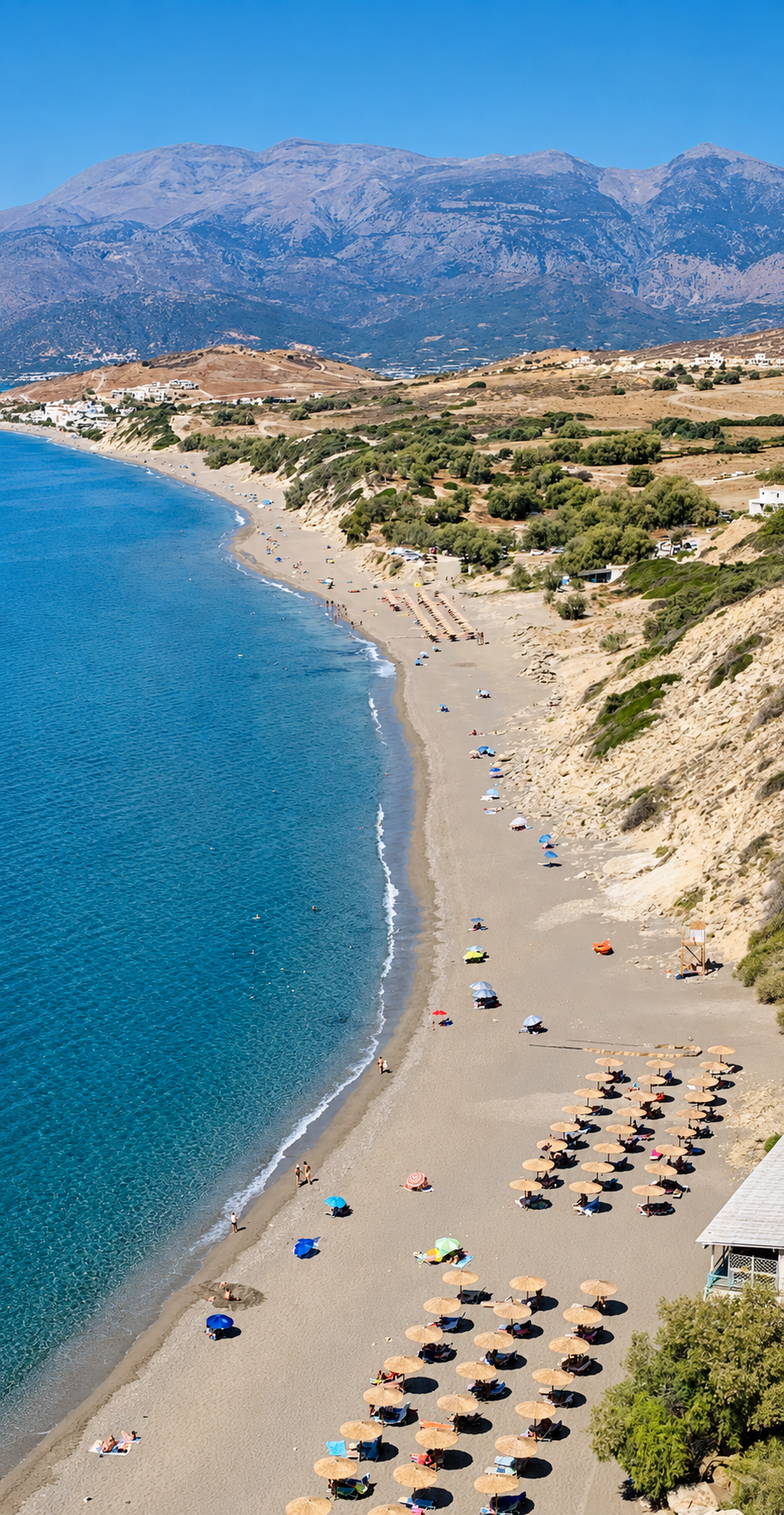
There are beaches you visit for the swimming. There are beaches you visit for the scenery. And then there is Kommos — a beach where you arrive for all of those reasons and leave having understood something about this coast that you didn't quite grasp before.
Kommos (sometimes spelled Komos — both are used, with the two-m version more common in English sources, though the archaeological site sign uses one) sits on the southern shore of the Messara Bay, two kilometres north of Matala, backed by sand dunes and tamarisk trees and the fenced perimeter of one of the most significant and least visited Minoan archaeological sites in the world. The beach is long — close to five kilometres if you count the entire coastal strip from the dunes at the north end to the rocks above Matala — and wide enough that it absorbs its visitors without apparent effort. Mount Psiloritis is visible to the north, its summit present for much of the year. To the east, the Asterousia mountains run toward the sea. Straight ahead, southward, the Libyan Sea stretches to the horizon without interruption.
In the late afternoon, the sun drops behind the sea or the distant mountains and the entire bay turns a colour that has no exact name in English. The two cliff-top tavernas above the south end of the beach, which have the best view of this moment of anywhere on the Messara coast, fill up accordingly.
The beach itself
Kommos is a protected coastal zone — part of the Natura 2000 European network — and the restrictions that come with that status are visible and felt. There are no hotels on the beach. No beach clubs, no sun lounger concessions running the full length, no permanent buildings behind the tamarisks. What development exists is modest and concentrated: a small organised section at the south end with some umbrellas and a canteen, and the rest of the beach essentially as it has always been.
The sand is coarser than the fine golden varieties of the postcard — a mix of sand and small pebbles that is characteristic of this stretch of coast and that the loggerhead sea turtles, as we will come to, find well suited to their purposes. The sea is clear and the snorkelling around the submerged rock formations offshore is rewarding, though visitors should be aware that the Messara Bay is exposed to the prevailing northwest winds and the sea can become rough quickly on a meltemi day. On those days the waves arrive with force. A rock about eighty metres offshore, called Volakas, is large enough to break the swell in its immediate vicinity but not enough to shelter the whole beach. Exercise caution when the wind is up.
On calm days, the beach is extraordinary.
The archaeology you cannot enter — and why it matters
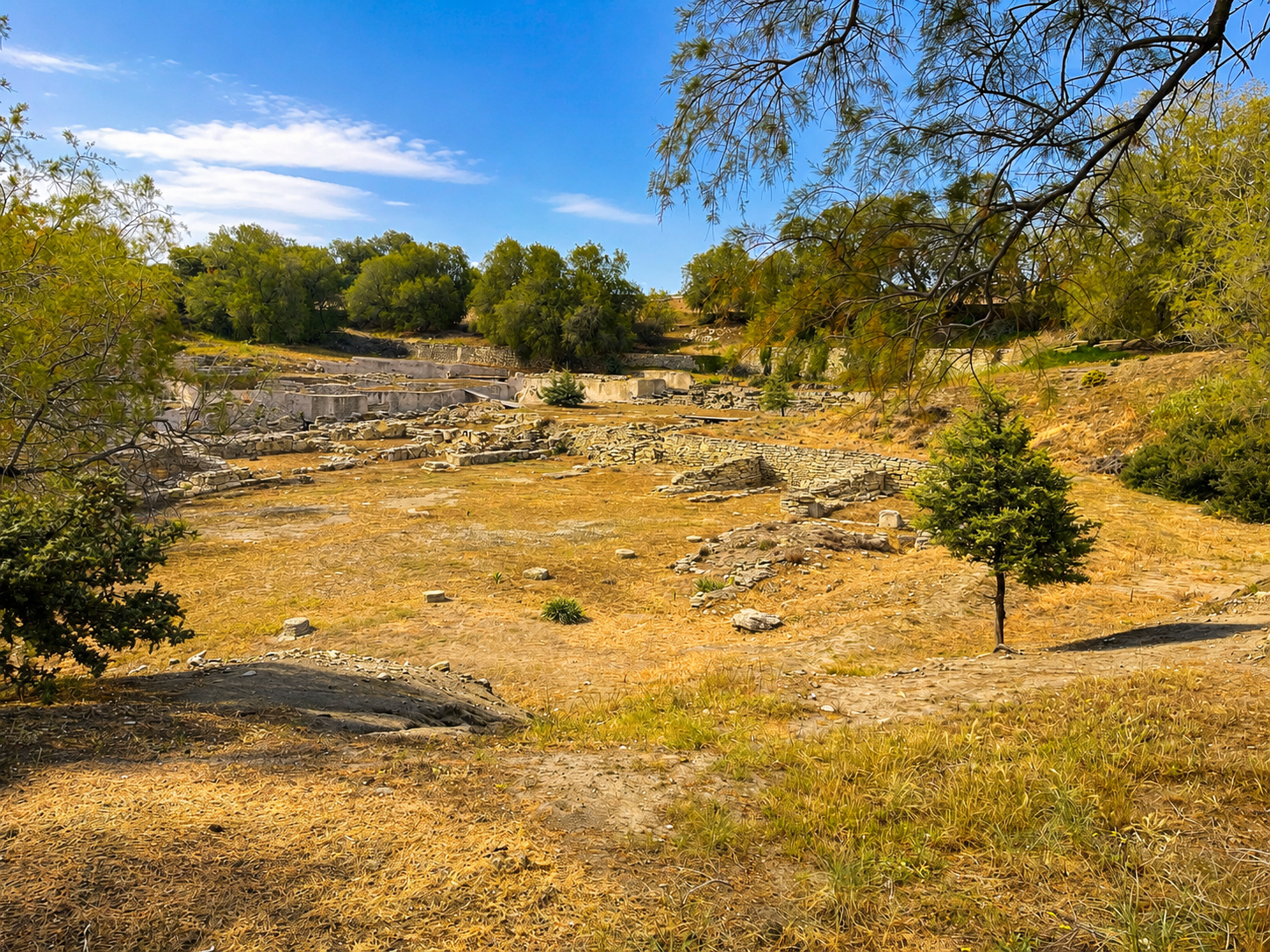
The fenced area running along the back of the beach is not, as it might appear to a first-time visitor, a building site or a private plot. It is the archaeological site of ancient Kommos — a Minoan harbour town of the first rank, currently not open to the public but visible in part from the road that descends to the beach and from the beach itself.
The history of Kommos is the history of the Messara and its relationship with the wider Mediterranean world. The settlement was established around 2000 BCE, in the period when the great Minoan palaces at Phaistos and Agia Triada were being built on the hilltops nearby. Kommos was their port — the place through which the Messara Plain's agricultural surplus flowed outward and through which goods from Cyprus, Egypt, Syria and beyond arrived inward. Archaeologists have uncovered what are believed to be the first Minoan shipsheds ever found: long galleried buildings designed to house and protect vessels, suggesting that Kommos was not merely a trading post but an active maritime facility capable of building and maintaining ships.
The site was excavated over thirty years, from 1976 to 2005, by the University of Toronto under Professors Joseph and Maria Shaw, in collaboration with the American School of Classical Studies at Athens. It was the first large-scale Canadian archaeological excavation in Greece, and its findings substantially revised the understanding of Minoan international trade. Among the imported pottery found here — from across the Bronze Age Mediterranean — the quantity and variety surpassed any other site of the period, confirming that Kommos was a place of genuine cosmopolitan significance.
Professor Shaw described Kommos as one point of a "Great Minoan Triangle," the other two vertices being Phaistos and Agia Triada. From that triangle, the Messara was administered, traded, and possibly governed for centuries.
The Minoan town was destroyed by earthquake, rebuilt, and eventually declined into the post-palatial period. But Kommos did not simply end with the Minoans. A Greek sanctuary was established here around 1000 BCE — built directly on the ruins of the Minoan palatial structures — and remained in continuous use for a thousand years, through the Geometric, Archaic, Classical, and Hellenistic periods. One of the three temples found within the sanctuary contained three tapering columns resembling Phoenician deities — a design with no parallel anywhere else on Crete, suggesting continued contact with the Levantine world long after the Minoan trade networks had dissolved.
There is also the story that Homer told, or that was told about Homer's characters. An ancient tradition held that the fleet of Menelaus, king of Sparta, returning from Troy after the fall of that city, was wrecked on this coast (see our guide on South Cretan myths). Whether the Trojan War was history or myth, the story of the shipwreck was taken seriously enough that the later inhabitants of Kommos built a sanctuary in Menelaus' honour. The place where the legend located a catastrophe became, in time, a place of worship. That is either the Cretan sense of economy or the Cretan sense of irony — probably both.
The site is currently closed to visitors. The Kommos Conservancy, a non-profit established by the excavation team, is working toward its eventual opening with proper pathways, protective shelters for the Greek temple area, and visitor facilities. Until then, what you can see from the beach — stone walls emerging from the dunes, the scale of the fenced perimeter — is enough to give a sense of what lies beneath the sand.
The sea turtles and Archelon
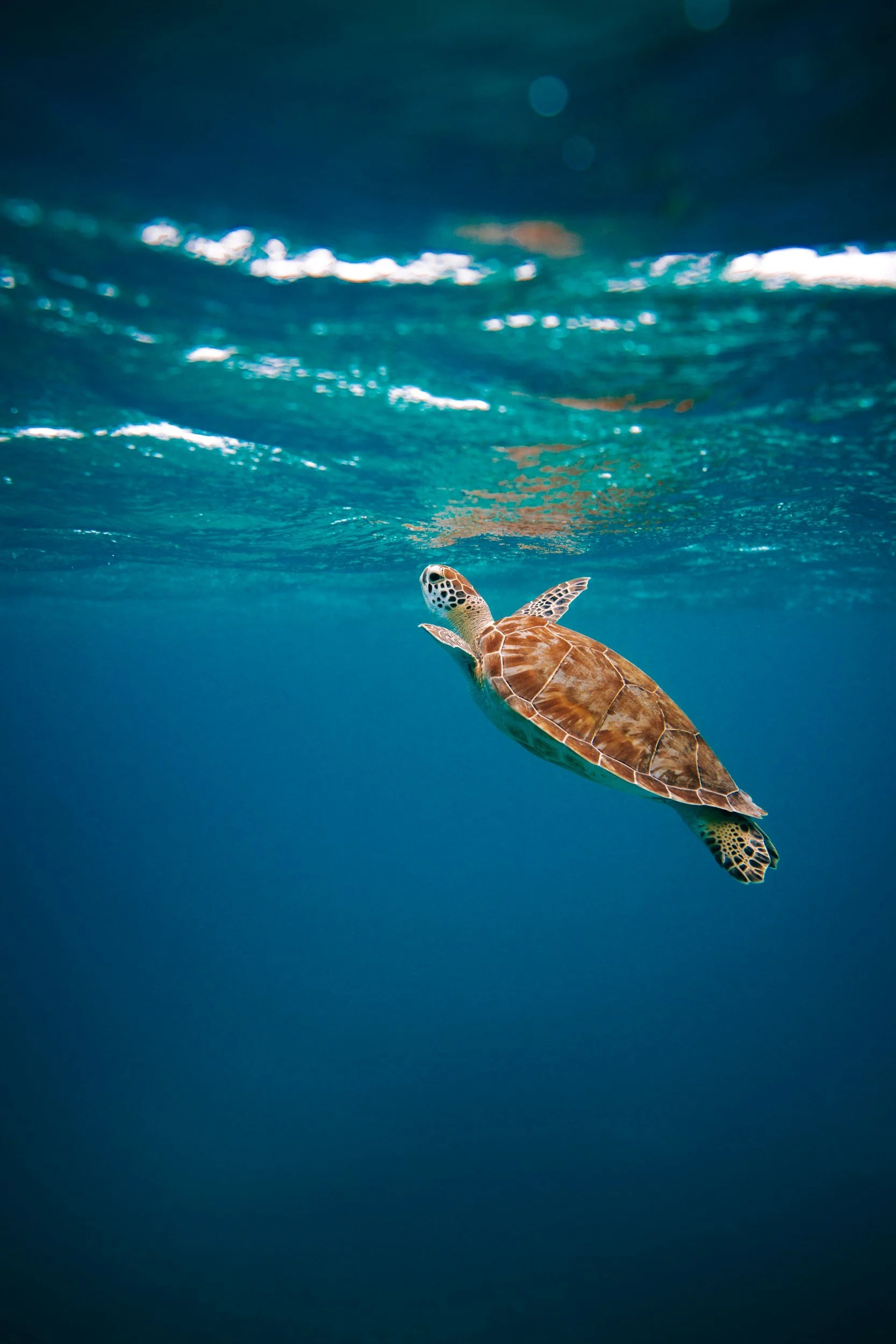
From May through August, parts of Kommos beach are marked by wire cages and wooden stakes, placed with quiet precision along the waterline. These are the loggerhead sea turtle nests — Caretta caretta, a species classified as Vulnerable by the IUCN — and the markings are the work of Archelon, the Sea Turtle Protection Society of Greece.
Archelon has been working on the beaches of Crete and the wider Greek coastline since 1984 — now in its 42nd year of conservation work. In 2025 alone, the organisation recorded and protected over 10,000 loggerhead nests across Greece. The Messara Bay is one of the three major nesting habitats in Crete, alongside the beaches of Rethymno and Chania. The loggerhead population nesting on Crete is genetically distinct from those nesting on Zakynthos and in the Peloponnese — which makes its protection not merely a matter of numbers but of preserving a unique lineage.
Each summer, Archelon volunteers base themselves at Matala and patrol the Kommos and Messara beaches, marking nests as they are laid, protecting them from trampling, and monitoring hatching. The wire cages placed over nests deter predators while allowing hatchlings to emerge. Nests considered at risk from wave inundation are relocated to safer positions on the beach.
Towards the end of summer, volunteers conduct nest excavations after hatching — collecting scientific data, counting hatched and unhatched eggs, and inviting members of the public to watch. If you are on the south coast in August or September, Archelon publishes a weekly schedule of these public excavations on their website at archelon.gr.
The practical message for beach visitors is straightforward: do not walk on the marked nests, do not set up umbrellas or leave belongings on the wire-marked areas overnight, keep the beach dark in the evening (lights disorient hatchlings making their way to the sea), and give the Archelon volunteers the cooperation they ask for. The coarse sand of Kommos, which looks like an inconvenience compared to finer beaches, is precisely what makes it attractive to nesting turtles — and precisely what the Natura 2000 protection is designed to preserve.
Nudism and the northern end
The northern section of Kommos beach, known locally as Potamos or Potamoserma, has a long-standing tradition of naturism that predates the beach's archaeological protection status by several decades. When the hippie communities of the 1970s dispersed from Matala — eventually asked to leave by the authorities — many moved north along the coast to Kommos and established informal camps in the dunes. The naturist tradition that developed during that period has persisted, and the northern end of the beach remains a recognised naturist area today, one of the more established and relaxed on the south coast. There are no official facilities and no enforcement either way; the convention is simply understood and respected.
Eating above the beach: the cliff tavernas
Above the south end of Kommos, on the cliffs between the beach and the village of Pitsidia, sit two restaurants that compete for the most dramatic dinner view on the Messara coast — and that together represent the best reason to time your Kommos visit around the evening.
Mystical View sits directly on the cliff edge, its terrace cantilevered above the drop with an unobstructed panorama of the entire bay. Lonely Planet describes it as having "million-dollar sunset views over Kommos Beach." The food is Greek and Mediterranean — fish and meat dishes, the kind of menu that earns its place from the setting as much as from the kitchen, though the kitchen is capable enough. The view, facing west across the open water, delivers the full Messara sunset as a free addition to every meal.
Aleko's Fish Taverne Vrachos sits beside it on the same clifftop — a family-owned place that began its life as a small pension above the beach and has built its reputation over generations on the quality of its seafood rather than the view alone. Aleko himself runs the terrace with warmth and fluency in multiple languages, and the fresh fish counter — from which you choose your fish before it reaches the kitchen — is the establishment's defining gesture. Tuna, sea bass, anchovies, octopus: the selection reflects what arrived that morning. House raki and fruit arrive at the end of the meal without being requested or charged. The view is not quite as dramatic as the Mystical View terrace next door, but the food, by general consensus, more than compensates.
For a sunset dinner above the sea with the entire bay spread below you and the light doing what it does to the water in the last hour before dark — either of these places earns a dedicated evening.
Getting there and what's nearby
Kommos is reached from the village of Pitsidia, which sits on the main road between Timbaki and Matala. The turn-off for the beach is signposted near the village. The road descends through the dunes to the beach — paved, manageable in a standard hire car, with parking at the bottom.
From Agia Galini, allow 25 minutes. From Matala, the beach is two kilometres north — a pleasant walk of around thirty minutes along the coastal path, passing through the dunes and past the archaeological site perimeter.
Matala itself is worth an afternoon — the cliff caves above the beach, the counterculture history, the seafood at the harbour. Phaistos is fifteen minutes inland — the Palace article in the STAYS Journal covers it in detail, and a morning at Phaistos followed by an afternoon at Kommos and a sunset dinner above the bay makes one of the more complete days available from a south coast base. Agia Triada, the smaller Minoan site that produced the sarcophagus now in the Heraklion museum, is nearby and rarely visited.
Our guide to the Palace of Phaistos and guide to the Archaeological Museum of Heraklion — where the finds from Kommos are held — sit alongside this article as natural reading companions.
Where to stay
Kommos is a beach that holds more history per square metre than almost any other on the south coast — Minoan shipsheds beneath the dunes, a Greek sanctuary built on their ruins, loggerhead nests marked in the sand every summer, the long memory of the hippie caravans, and two tavernas on the cliff above it all watching the sun go down over the Libyan Sea. Most people who come here come for the swimming. Most people who come back come for the rest of it.
The STAYS properties closest to Kommos sit in the Klima and Tymbaki area, just inland from the Messara coast. Villa Ilisio, a stylish retreat in Klima surrounded by nature, and Saitis Home, an elegant home in Timbaki with jacuzzi and sea views, are both within easy reach of the beach, Matala, and Phaistos. Klima Breeze, also in the area, completes the trio of properties best positioned for exploring this particular corner of the south coast.
For those still deciding between the Messara area and other parts of the south coast, our guide to where to stay in South Crete covers the character of each area, and the full Home Collection is on the STAYS site.
