
Beyond the Minotaur: The Forgotten Myths of South Crete
Beyond the famous myths of Knossos and Crete being the island where Zeus was nurtured to strength as a baby lies another mythical landscape: the cliffs of the Bay of Messara, the plains of Phaistos, the islands of Paximadia and the waters of the Libyan Sea.
Mention Crete in polite company and somebody will eventually bring up the Minotaur.
It is almost inevitable. The unfortunate creature has become the island's unofficial mascot — half bull, half man, entirely the product of a domestic situation that would tax even the most diplomatic of family therapists. There is the labyrinth, naturally. There is Theseus, heroic and moderately cunning. There is Ariadne, considerably more cunning, handing out balls of thread with the patient air of someone who has learned not to rely on men for directions. And presiding over the whole affair, King Minos, running what was, if we are honest, a rather dysfunctional family business with more mythology than management.
Fair enough. The story is famous for a reason.
But here is the small problem.
The Minotaur lived in Knossos. Knossos is in northern Crete. And South Crete — the wild, cliff-edged, Libyan-Sea-facing southern coast — has always told entirely different stories.
Stand on the cliffs above Agios Pavlos, walk the beach at Kommos, or watch the sun dissolve beyond the Paximadia Islands, and the landscape begins to suggest myths of a different character altogether. Not labyrinths and palace intrigue, but open water, sea crossings, dolphins, and distant horizons. The mythology of the south is an outward-facing mythology. Its characters don't hide in underground chambers. They sail.
Perhaps that should not surprise us. For thousands of years, the people of this coast woke up facing the open Libyan Sea. Africa was somewhere out there beyond the horizon, closer than most of northern Europe. Every morning they looked south. Every evening they watched islands rise from the glittering water and disappear again into darkness. It was only natural that their stories should travel by sea as well.
Europa and the First Journey to Crete
If there is one story that can reasonably claim to be Europe's origin myth — as in, the myth from which the entire continent takes its name — it is the tale of Europa.
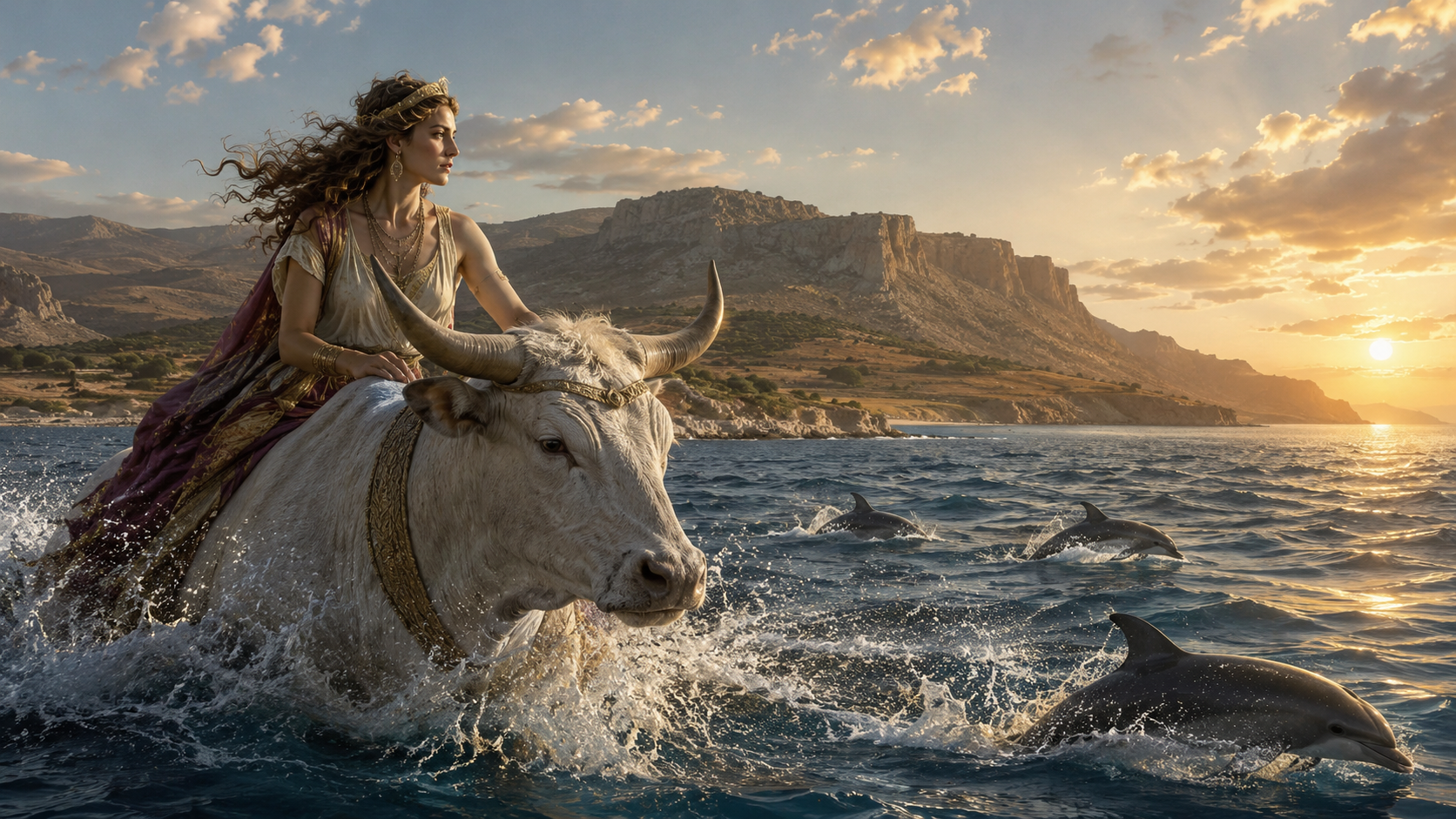
Europa was a Phoenician princess living on the coast of what is now Lebanon. One day Zeus caught sight of her and, displaying the characteristic restraint for which the king of the gods is so widely admired, immediately lost all capacity for rational decision-making. His solution, as so often, involved a disguise. He transformed himself into a magnificent white bull — gleaming, gentle, implausibly attractive — and ambled casually into Europa's vicinity.
Europa, captivated and apparently somewhat less suspicious than the situation warranted, climbed onto the bull's back.
The bull ran into the sea.
The poet Moschus, writing in the second century BCE, describes the crossing with a vividness that three thousand years of subsequent poetry has not entirely surpassed. As Europa looked around her, the reality of her situation became unavoidably clear:
"She could see neither wave-beat shore nor mountain-top, but only sky above and sea without end below."
The sea calmed before them. Dolphins accompanied their passage. Sea deities rose from the depths to pay their respects. And eventually the bull revealed his true identity with the disarming directness that only a god can manage when caught out:
"'Tis Zeus himself that speaketh, though to the sight he seem a bull."
Europa arrived in Crete.
Where exactly? That question has kept local tradition busy for centuries. Several versions place her landfall somewhere on the southern coast — at Matala, or at Kommos, the ancient Minoan harbour below Phaistos whose ruins still lie buried in the dunes above the beach. Whether this preserves an ancient geographical memory or a later piece of local enthusiasm for the tourist trade is, at this distance, impossible to establish with certainty.
What is rather easier to establish is that if Europa did approach Crete from the south — as one crossing the Libyan Sea from the east would naturally do — the first coastline she would have seen might have looked remarkably similar to the one visitors admire today. The cliffs are still there. The sea still does what it does in the late afternoon. The Paximadia Islands still hover on the horizon with the slightly theatrical air of islands that know they are being watched.
The Tree That Never Lost Its Leaves
Europa arrived in Crete. But the story does not end at the shoreline.
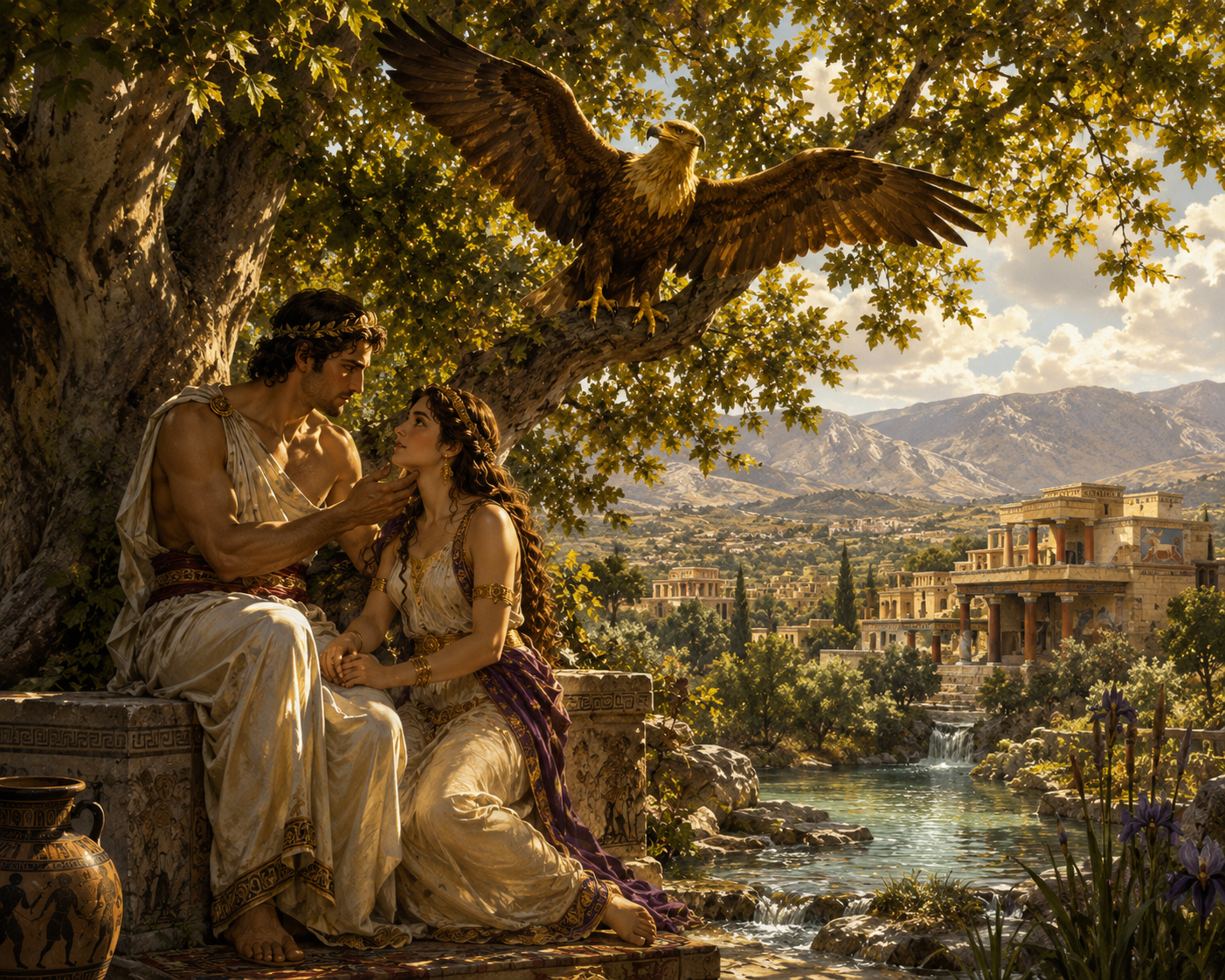
Ancient tradition held that Zeus, having safely delivered his Phoenician princess across the Libyan Sea, did not immediately revert to standard divine behaviour and disappear in a cloud of obligation. Instead — and this is where South Crete's mythological geography becomes pleasingly specific — he transformed himself once more, this time into an eagle, and carried Europa inland to Gortyn, the great city of the Messara Plain, thirty minutes east of Phaistos.
There, beside a spring on the banks of the river Lethaeus, stood a plane tree.
Under this tree, Zeus revealed himself. Under this tree, according to the myth, the union that would produce the three kings of Minoan Crete took place. Minos, Rhadamanthys and Sarpedon — the rulers of Knossos, Phaistos and Malia — all owe their existence to this particular spot beside this particular spring in the Messara.
The tree has never lost its leaves since. Unlike every other plane tree in the Mediterranean, which dutifully sheds its foliage each autumn in the standard deciduous fashion, the plane tree of Gortyn remains evergreen. Only about 50 documented specimens of this evergreen subspecies exist across the entire island of Crete. Ancient coins minted at Gortyn depicted Europa beneath its branches. Local women once gathered its leaves in the belief that they possessed particular properties in matters of fertility. The tree that stands at the archaeological site today — modest in size but extraordinary in claimed longevity — may or may not be the original. Plane trees, it turns out, can regenerate from their roots across millennia, which makes the question of its age both unanswerable and somewhat beside the point.
What makes this myth worth pausing over is what lies beneath it. Before Zeus arrived in the mythology of South Crete, there was another god entirely. Velchanos — or Welchanos in the original Minoan — was an ancient deity of vegetation worshipped across the island long before the Greeks brought their own pantheon to replace the local one. He was young, beardless, and perpetually associated with trees. Coins minted at Phaistos, in the fourth century BCE, show him seated in a tree, holding a rooster. The sanctuary at Agia Triada, in the shadow of the Minoan palace, was dedicated in the Hellenistic period to Zeus Velchanos — a compound name that preserves, in its very structure, the evidence of one religion absorbing another.
The evergreen plane tree at Gortyn, in other words, may be older than the myth that now explains it. The Greeks arrived, looked at a tree that had apparently never lost its leaves, heard a local story that nobody could quite account for, and did what the Greeks always did with inexplicable local phenomena: they gave it a myth. The Minoan Velchanos, god of trees and vegetation, quietly became Zeus. The sacred tree became the marriage bed of a Phoenician princess. The local cult became a chapter in the story of Europe's origins.
You can visit the tree today. It stands behind the Odeon at Gortyn, a twenty-minute drive from Phaistos, marked by a small sign that manages to understate the situation considerably. It is not a spectacular tree. It is, in fact, rather an ordinary-looking plane tree with the slight air of something that has been photographed more than it deserves.
And then you remember what it is supposedly standing in for, and it becomes rather more interesting.
Menelaus and the Dangerous Coast
The Libyan Sea may look peaceful from a taverna terrace.
Homer knew better.
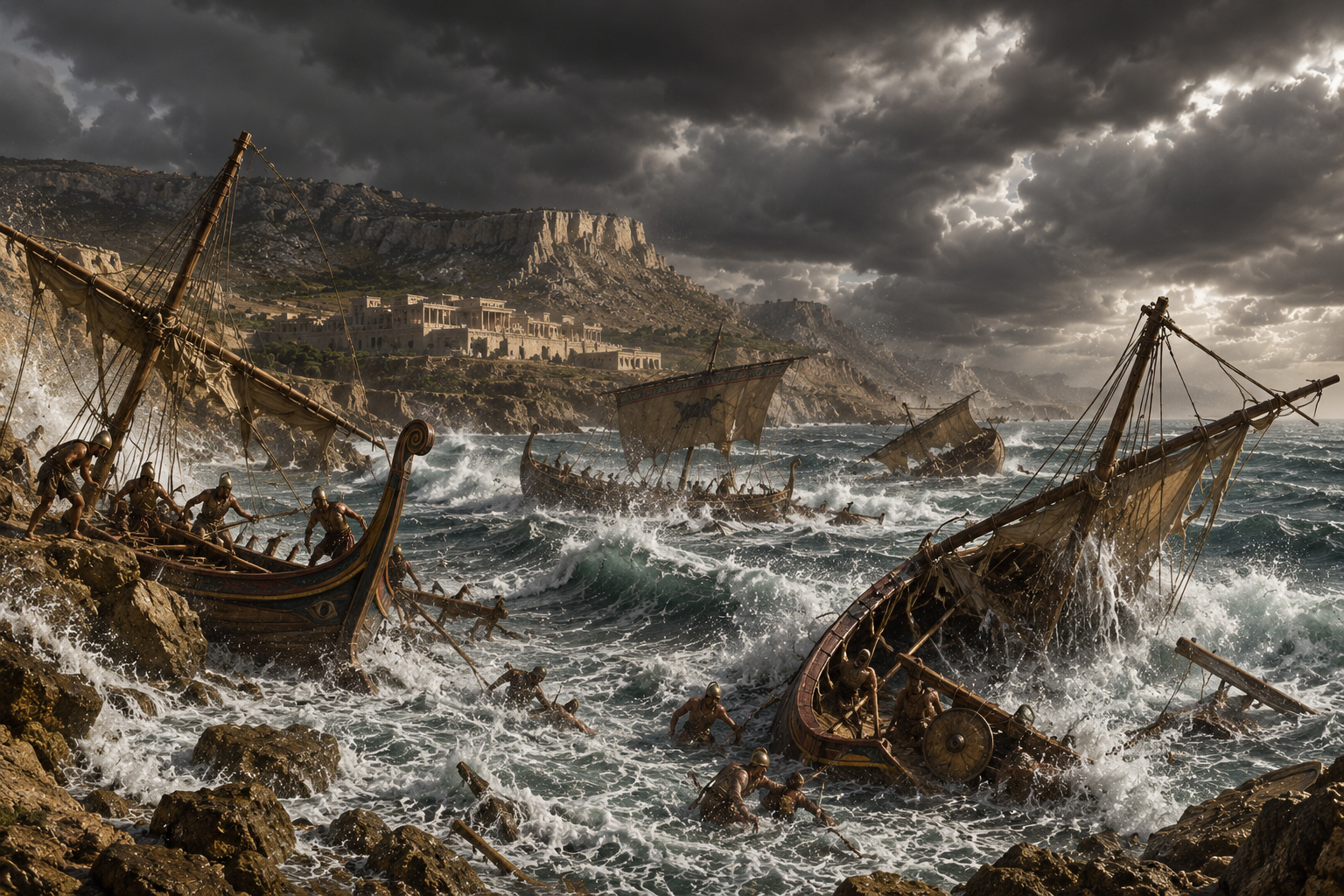
In the Odyssey, while cataloguing the various disastrous return journeys of the Greek heroes after the fall of Troy — a catalogue which suggests that winning a war is considerably easier than getting home afterwards — he describes part of Menelaus' fleet reaching the southern coast of Crete.
What follows is geography of surprising specificity for an epic poem:
"a high headland... stretching out into the sea from a place called Gortyn"
and:
"all along this part of the coast as far as Phaestus the sea runs high when there is a south wind blowing."
Anyone who has spent enough time on the south coast will find this passage oddly familiar. Three thousand years of Mediterranean meteorology have not fundamentally altered the situation. Local fishermen and tourist boat operators would probably nod in recognition. The outcome for Menelaus, predictably, was not good:
"Here this part of the fleet was driven on to the rocks and wrecked."
What makes the passage so remarkable is that Homer is not describing some conveniently vague fantasy coastline. He is describing a real place. A specific headland. A particular stretch of sea between Gortyn and Phaistos where the south wind creates conditions that apparently destroyed ancient warships and continue to inconvenience modern sailing vessels. The landscape that visitors drive through today — past Kommos, past Matala, toward the plains of the Messara — is the same landscape Homer was describing. The names have changed slightly. The cliffs have not.
The mythology of South Crete, in other words, is not merely decorative. It is topographically accurate.
Talos: The World's First Robot
There is one figure in South Cretan mythology who tends to stop people mid-sentence when they first encounter him. Not because he is particularly frightening — though he is, rather — but because of what he is.
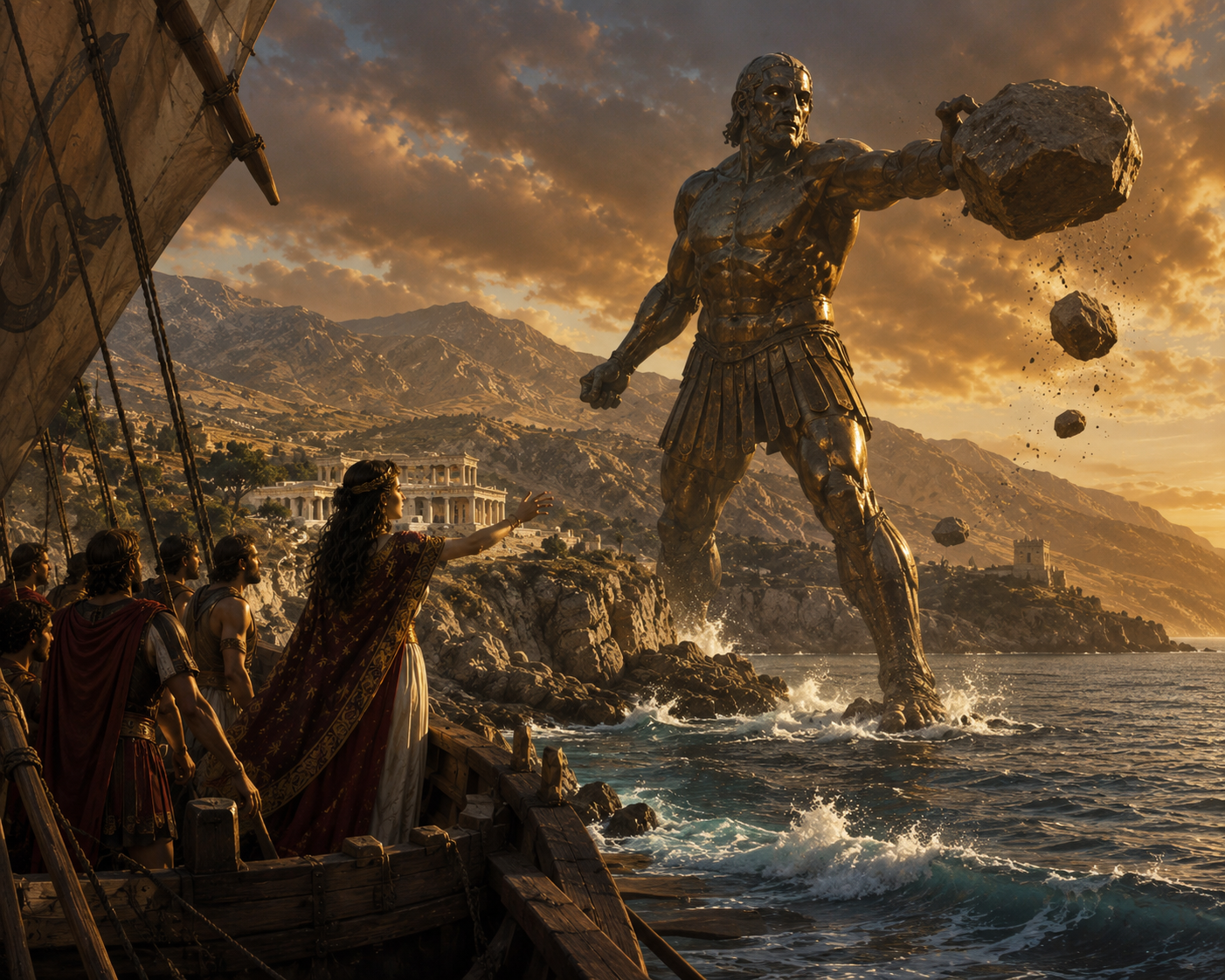
Talos was a man made of bronze. Not a man who happened to be very tough, or a warrior so formidable that later generations reached for the metaphor of metal. An actual bronze automaton, forged by Hephaestus, the divine smith, and animated by a single vein of ichor — the golden fluid that serves as the blood of the gods — running from his neck to his ankle, where it was sealed by a bronze nail. He was, in the most literal sense available to the ancient world, a robot.
He was also, according to the most widely accepted version of the myth, a gift from Zeus to Europa.
One can see the logic. Zeus had just carried Europa across the Libyan Sea, deposited her in Crete, and was presumably conscious that a Phoenician princess left alone on a Mediterranean island without security arrangements might reasonably feel exposed. The solution — a tireless bronze giant who could not be bribed, did not require sleep, and experienced neither boredom nor inconvenient personal loyalties — was, as divine gifts go, rather well considered.
Talos' job was to patrol the coastline of Crete. He circled the island three times a day, which even accounting for his prodigious stride suggests a considerable commitment to the role. Any ship approaching without permission was met with boulders, hurled with the confident accuracy of something that has been doing this for a very long time and has no reason to stop. Apollonius of Rhodes, writing in the third century BCE, describes the Argonauts — Jason, Medea, and their generally heroic companions — being driven away from the Cretan shore by exactly this method. The great ship Argo, which had survived the Symplegades and the various other inconveniences of the Black Sea voyage, was apparently not equipped to handle a bronze giant throwing rocks from the beach.
This is where Medea becomes relevant.
Medea was, by any reasonable assessment, the most formidable person on the Argonauts' voyage. She was a sorceress of the first rank, the granddaughter of Helios, and had already demonstrated at several points in the journey that the distinction between her and the gods was primarily administrative rather than practical. She looked at Talos — invulnerable, enormous, hurling boulders with the enthusiasm of something with no other responsibilities — and identified the weakness.
The bronze nail in the ankle.
Her solution involved bewitching Talos into a state of divine madness — she was thorough in this, as in most things — during which the giant grazed his ankle on a sharp rock. The nail came loose. The ichor poured out. And Talos, the bronze guardian of the Cretan coast, the world's first automaton, the divine gift to a Phoenician princess who had crossed the Libyan Sea on the back of a god, toppled into the water and was still.
The connection to the southern coastline is not incidental. Talos in the Cretan dialect meant sun — the same word that gives us Helios in standard Greek — and several ancient traditions identify him not merely as a manufactured guardian but as the ancient Cretan sun deity, a god predating the Greek arrival on the island, absorbed into mythology the way Velchanos was absorbed into Zeus: incompletely, with the seams showing. The coins of Phaistos, which depicted Velchanos in his tree, also carried images that scholars have connected to the solar traditions from which Talos emerged. The south coast, facing Africa, getting more sun than anywhere else on the island, producing the hottest summers, the driest landscapes, the most exposed cliffs — this was always, in some sense, his territory.
Whether Talos actually fell into the Libyan Sea is between Apollonius and the reader. What is rather harder to dispute is that the ancient world invented the concept of artificial intelligence — a being made rather than born, animated by a power source running through a single vulnerable conduit, performing a programmed task with inhuman consistency — and located it on the coast of South Crete.
Alan Turing, who asked in 1950 whether machines could think, was roughly two and a half thousand years behind schedule.
Apollo and the Cretan Sailors
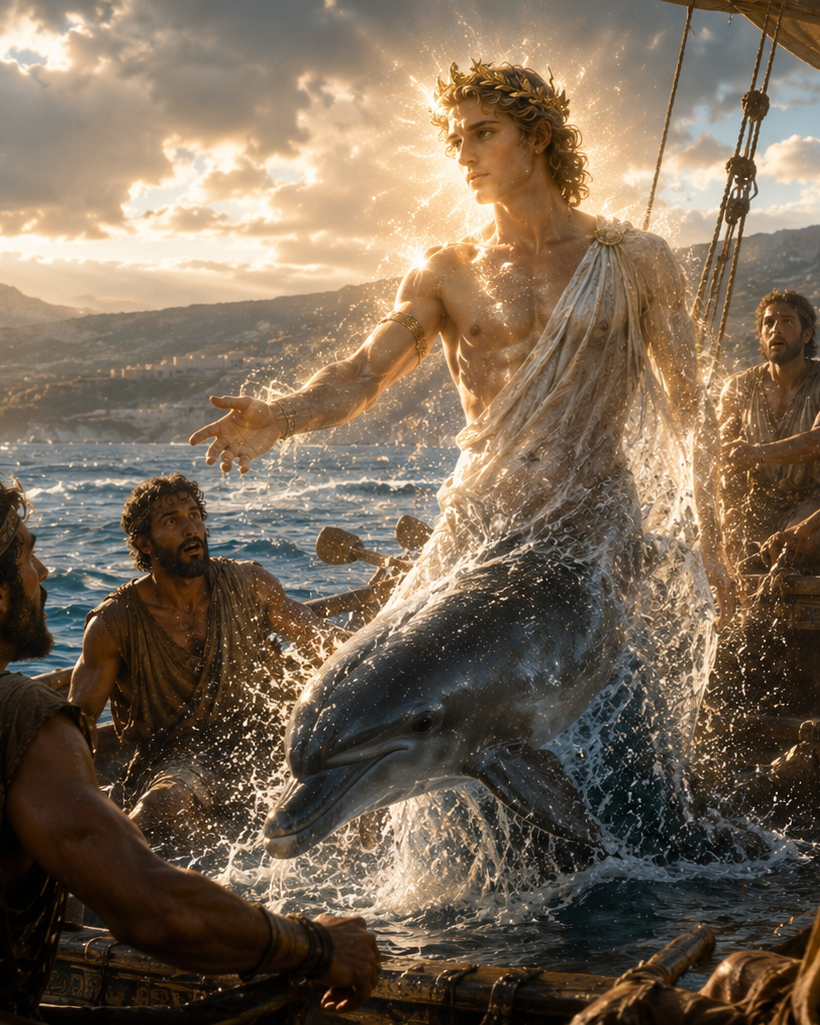
A small confession is required before this section begins.
The myth that follows is not, strictly speaking, anchored in South Crete. It belongs to Crete as a whole — specifically to Knossos, which sits firmly on the northern coast and has already been established as belonging to a different chapter of the island's mythology. The author is aware of this geographical inconsistency and has decided to include the story anyway, on the grounds that it is simply too extraordinary to omit, and that Knossos kept its ships somewhere, and the Libyan Sea was the road those ships knew best.
The reader may consider this either an editorial lapse or an act of considerable generosity. Either interpretation is welcome.
Now. Apollo needed priests…
The most surprising myth in this collection is also probably the least well known, which seems unjust given that it concerns the founding of one of the most important religious sites in the ancient world.
Most people know Delphi. The oracle. The navel of the world. The place where Greeks went to ask difficult questions and received answers that were, in the finest tradition of divine communication, technically accurate while being practically useless.
What very few people realise is that one of the oldest surviving accounts of how Delphi came to exist begins with a group of sailors from Crete. Not from the south coast, as has been established with perhaps excessive candour in the preceding paragraph — but from Crete nonetheless, which is close enough for our purposes and considerably more interesting than if they had come from anywhere else.
In the Homeric Hymn to Apollo, the god is searching for priests to staff his newly founded sanctuary. Rather than selecting suitable candidates from the Greek mainland — which would have been geographically logical — Apollo decides he wants Cretans. Specifically, in the hymn's own description:
"Cretans from Minoan Cnossus."
His method of recruitment is characteristic. He transforms himself into a dolphin and leaps aboard their ship. The sailors, understandably baffled by this development, find themselves unable to steer and are carried across the sea by divine will until they arrive at the site of the new sanctuary. There, Apollo reveals himself with the confident authority of someone who has not remotely acknowledged how strange the preceding events have been:
"I am the son of Zeus, and name myself Apollo, and hither have I brought you over the great gulf of the sea."
The Cretan sailors become the first priests of Delphi. And Delphi itself — the ancient Greeks believed — was named after the dolphin shape Apollo chose to appear in.
In other words: one of the most significant religious institutions of classical antiquity traces its mythological origins, at least in part, to a group of Cretan seafarers who simply set sail one morning and had an extremely unusual voyage. The sea, once again, is not merely scenery. It is the mechanism by which history — or at least the history that mythology preserves — moves from one place to another.
The Islands of Leto
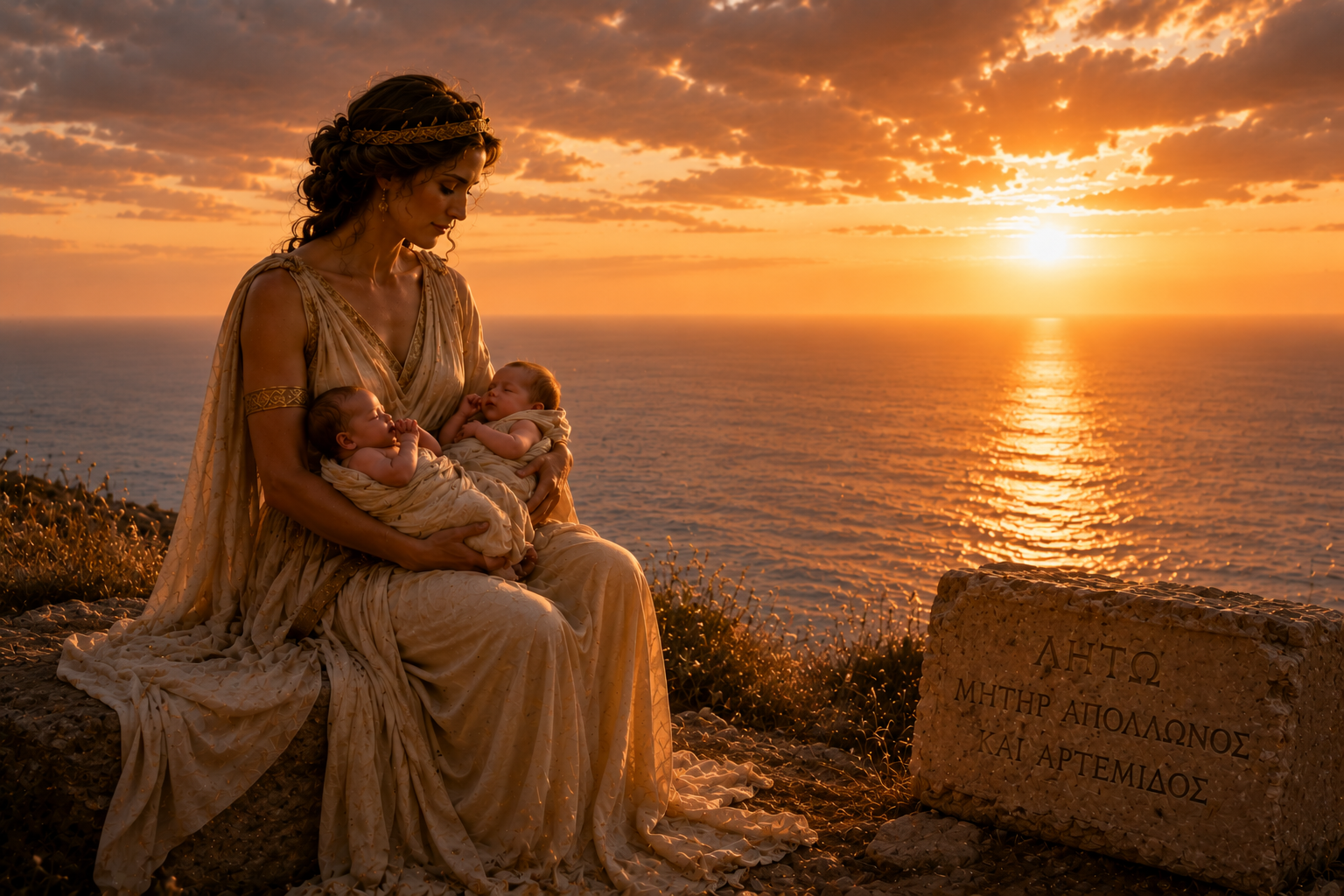
Eventually, every conversation about South Crete arrives at the same question.
What are those islands?
Visible from Agia Galini, from Triopetra, from Agios Pavlos, from the hills above Saktouria, from the clifftop tavernas above Kommos — the Paximadia Islands sit on the southern horizon with a presence that is somehow both reassuring and faintly unsettling.
They are too far to swim to and too close to ignore. They appear at different distances depending on the atmospheric conditions. In the early morning they can seem almost reachable. At noon they recede. At sunset they become silhouettes of improbable beauty.
The ancient world noticed this too.
Ptolemaeus, in his Geography, records an island south of Crete called Letoa — the island of Leto, mother of Apollo and Artemis. Later Cretan tradition connected the Paximadia with this divine family, and in some local versions the islands are associated with the birth of Apollo and Artemis themselves — a rival claim to the more widely accepted tradition that placed the birth of the divine twins on Delos.
Whether the story generated the name or the name generated the story is the kind of question that classical scholars argue about at considerable length and rarely resolve. What is clear is that the association feels somehow right. The Paximadia hover between sea and sky in exactly the manner that mythology requires of its sacred geography. Visible yet distant. Close enough to tempt. Far enough to remain mysterious. The sort of place a goddess might reasonably choose if she wanted a birth location with appropriate dramatic lighting.
A Myth That Probably Doesn't Belong Here
One myth that visitors to Agia Galini are almost guaranteed to encounter is the story of Daedalus and Icarus. Two statues stand above the harbour, gazing seaward with the resigned expression of people who know the ending. Local tradition claims that this was where the master craftsman and his son launched their famous escape from Crete — that from this very harbour, Daedalus fitted his wings of wax and feathers and watched his son fly, famously, in entirely the wrong direction.
It is a wonderful story.
The problem is that the ancient sources never actually say this.
The tale of Daedalus and Icarus belongs firmly to the world of Minos, the Labyrinth, and Knossos. The imprisonment, the construction of the wings, the escape — all of it takes place in the orbit of the northern palace. The idea that the flight began in Agia Galini is a considerably later local tradition, constructed with more enthusiasm than textual evidence.
This does not make the statues any less charming. And in a certain light, with the sea below and the Paximadia on the horizon, the location is so suited to the story that it almost doesn't matter whether the ancient poets had it right.
Almost.
Some myths were created by Homer. Others, it must be said, were created by local tourism committees. The visitor to South Crete is entitled to enjoy both, while retaining the ability to tell them apart.
Looking Beyond the Horizon
The myths of northern Crete happen behind walls. The Labyrinth. The palace. The enclosed court. The great Minoan buildings at Knossos and Phaistos were structures built to contain — grain, people, power, ritual. Their mythology is similarly interior. Things happen inside. Secrets are kept. Monsters are hidden.
The myths of South Crete happen beyond the horizon. Europa crosses the open sea. Menelaus' fleet is wrecked on the exposed southern cliffs. Apollo's chosen priests are carried across the water by divine compulsion. Even Paximadia — sitting on the horizon like a divine staging post — belongs to a mythology of distance rather than enclosure.
They are stories of departures rather than arrivals. Of voyages rather than kingdoms. Of sailors who set out not entirely sure where they were going, guided by something they could not entirely explain, and ending up somewhere they had not planned on being.
Which is, come to think of it, not a bad description of how most good holidays begin.
Stand on the cliffs above the Libyan Sea at sunset. Watch the Paximadia fade into silhouette. Look south toward the open water. Then remember that for thousands of years people have stood in exactly the same place, looking at exactly the same horizon, wondering what stories might be hiding beyond it.
The myths may or may not be true. The places are.
The landscapes described in this article are explored in more detail across the STAYS Journal. Our guide to the Palace of Phaistos covers the Minoan site above the plains of the Messara. The Kommos beach guide tells the full story of the ancient harbour buried in the dunes. The Agia Galini guide covers the town where Daedalus may or may not have taken flight. And the hidden archaeology of South Crete goes further into the coastal settlements and Minoan remains along the Libyan Sea coast that most visitors never find.
If these stories inspire you to explore the landscape in person, the STAYS Home Collection places you within easy reach of almost all of it — from the shores below Agios Pavlos to the ancient plains above Kommos. Our guide to where to stay in South Crete covers which base suits which kind of week.
