
Wildfires in Crete: Causes, History and What Visitors Should Know
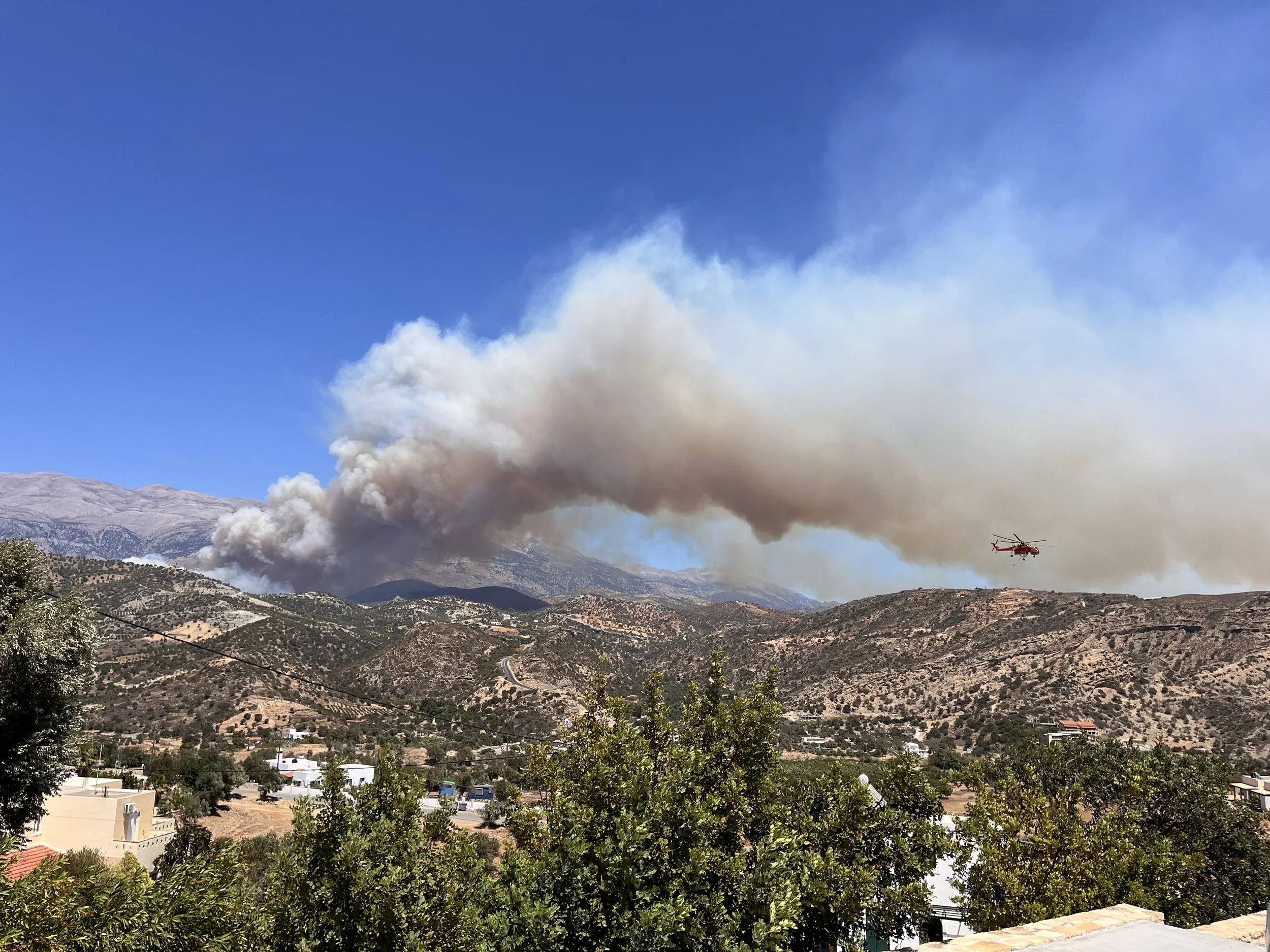
If you spend any time in Crete between June and September, you might see smoke on a hillside. Most summers it is simply a distant plume above a ridge, gone by evening. Other summers it is something considerably more serious — villages evacuated, hillsides stripped to the rock, the smell of burning carried on the wind. On the days when a fire burns within range of the coast, the sky takes on a colour that has no real equivalent in ordinary weather — a deep amber that turns the sea copper and the white walls of the village orange, the sun reduced to a red disc visible through the smoke long before it reaches the horizon.
It is unsettling the first time. It is also, in its way, extraordinary. Wildfires are part of life on this island, and understanding them — their causes, their frequency, their destructive and regenerative powers, their relationship to the landscape and their long history — is part of understanding Crete itself.
This is not at all a reason to avoid coming. It is a reason to come informed.
A landscape shaped by fire
Fire in the Mediterranean is not a modern problem. It is an ancient force, as old as the dry summers and the accumulated vegetation of the maquis and phrygana — the dense, aromatic scrubland that covers much of the Cretan hillside and that burns, when conditions are right, with formidable intensity.
The Mediterranean basin has the highest fire incidence of any region outside the tropics. Over millennia, the plants that cover its hillsides have adapted accordingly. Many species in the maquis and phrygana communities of Crete — cistus, kermes oak, wild thyme, thorny burnet — have developed fire-survival strategies encoded over thousands of generations. Some resprout from protected root systems within weeks of a fire passing over them. Others produce seeds whose germination is triggered by smoke or heat, lying dormant until a fire clears the competition above them. The Cretan landscape has been burning and regenerating in this way since long before humans arrived to complicate matters.
The phrygana communities that dominate much of the south coast — the low scrub that smells of thyme and oregano and sage when you walk through it, the ground cover that turns green after winter rains and becomes fuel by August — are in many respects fire-adapted ecosystems. Ecologists have recognised since at least the 1970s that fire plays a role in maintaining the diversity of these plant communities, clearing accumulated biomass, returning nutrients to the soil, and creating the mosaic of vegetation ages and densities that supports a wider range of species than an unburned monoculture would. The widely held assumption that wildfire is purely destructive to Mediterranean ecosystems is ecologically incomplete, even if it is understandably popular.
The role of ash in this cycle is worth understanding in its own right. When vegetation burns, the ash that remains is not simply waste — it is a mineral concentrate of everything the plant accumulated over its lifetime. Ash raises soil pH, releases phosphorus, potassium, and calcium in forms that plant roots can absorb directly, and suppresses certain soil pathogens. It is, in effect, a natural fertiliser, applied suddenly and in large quantities to ground that has just been cleared of competition. This is part of why the Mediterranean hillside can look startlingly green within a single growing season after a fire: the conditions for new growth are, paradoxically, better in the months immediately after burning than they were in the dense, accumulated scrub that preceded it. The landscape is not simply recovering from the fire. In a biological sense, it is partly benefiting from it.
This does not mean that all fires are ecologically neutral. Frequency matters. Severity matters. The interval between fires determines whether an ecosystem recovers or degrades. A hillside that burns every forty years recovers. A hillside that burns every five years — the scenario climate modelling suggests is increasingly possible under higher emissions trajectories — may not.
How many fires, and where
Crete has averaged over 600 non-agricultural fires per year exceeding one hectare over the past two decades, according to data from the Hellenic Fire Service. That number does not include the smaller incidents — cigarettes, agricultural burning gone wrong, sparks from power lines — that are contained quickly and never make a report. In terms of the number of ignitions across Greece as a whole, researchers estimate roughly 10,000 per year.
The island's forest cover is modest by northern European standards: natural forest covers approximately 17–18 percent of Crete's land area, amounting to around 145,000–150,000 hectares, according to Global Forest Watch. The vegetation most at risk from fire — the transitional zone between forest and open scrub — is where the largest fires tend to run.
The south and central parts of the island, including the areas around Agia Galini, the Messara Plain, and the foothills of Psiloritis, are classified in fire risk modelling as among the most exposed areas on the island. This reflects the combination of dry summers, rugged terrain, and the accumulated fuel load of the maquis. Academic modelling of future fire risk for Crete, published in 2023, found that the south and central areas are projected to reach "very high" risk levels by the latter part of this century under higher emissions scenarios.
The question of cause
The intuitive assumption is that wildfires in Crete and across Greece are becoming more frequent because of climate change. The data tells a more complicated story — and in some respects a less alarming one, at least about the forces driving the trend.
Fire is not new to the Mediterranean. It is not even new at scale. Historical records and ecological evidence suggest that fire frequency in the region was actually higher during earlier periods of active pastoral and agricultural use, when burning was a routine land management tool — used to clear scrubland, regenerate grazing pasture, and maintain the open landscapes that traditional farming required. Shepherds burned hillsides. Farmers cleared land with fire. The interval between burns on many Cretan hillsides was measured in years, not decades.
What changed was not the climate but the people. From the mid-twentieth century onward, rural depopulation accelerated across Greece and the wider Mediterranean. Villages emptied. Grazing declined. The traditional practices that had kept hillside fuel loads in check — intentional burning, heavy grazing, active scrub clearance — largely stopped. The vegetation that had previously been managed grew unchecked for decades, accumulating the kind of dense, continuous fuel load that turns a routine ignition into an uncontrollable fire. The hillsides around Melambes, Satokuria, and the Amari Valley — all of which have burned in recent years — are landscapes that were once actively farmed and grazed. The fuel that fed those fires had been building for a generation.
This is the factor that most fire researchers now identify as the primary driver of the increase in large, catastrophic fires in the Mediterranean: not the number of ignitions, which has remained broadly stable over the long term, and not climate change alone, but the interaction between accumulated fuel and the conditions — high temperatures, low humidity, strong winds — that climate change is making more frequent and more extreme. The fires are bigger and harder to control than they were fifty years ago largely because there is more to burn, and because the landscape that carries that fuel is no longer being actively managed by the people who once lived in it.
Climate change is genuinely part of the picture. Hotter summers extend the fire season and reduce fuel moisture to the point where ignition is easier and spread is faster. The record-breaking heat of recent Greek summers — 2021, 2023, 2024 — has repeatedly created conditions in which fires that might once have been contained became regional emergencies. But to present climate change as the sole or even primary explanation for the increase in destructive fires is to miss the larger and more tractable story: that a different relationship between people and landscape — more managed, more inhabited, more actively farmed — would reduce fire risk significantly, regardless of what the thermometer reads in August.
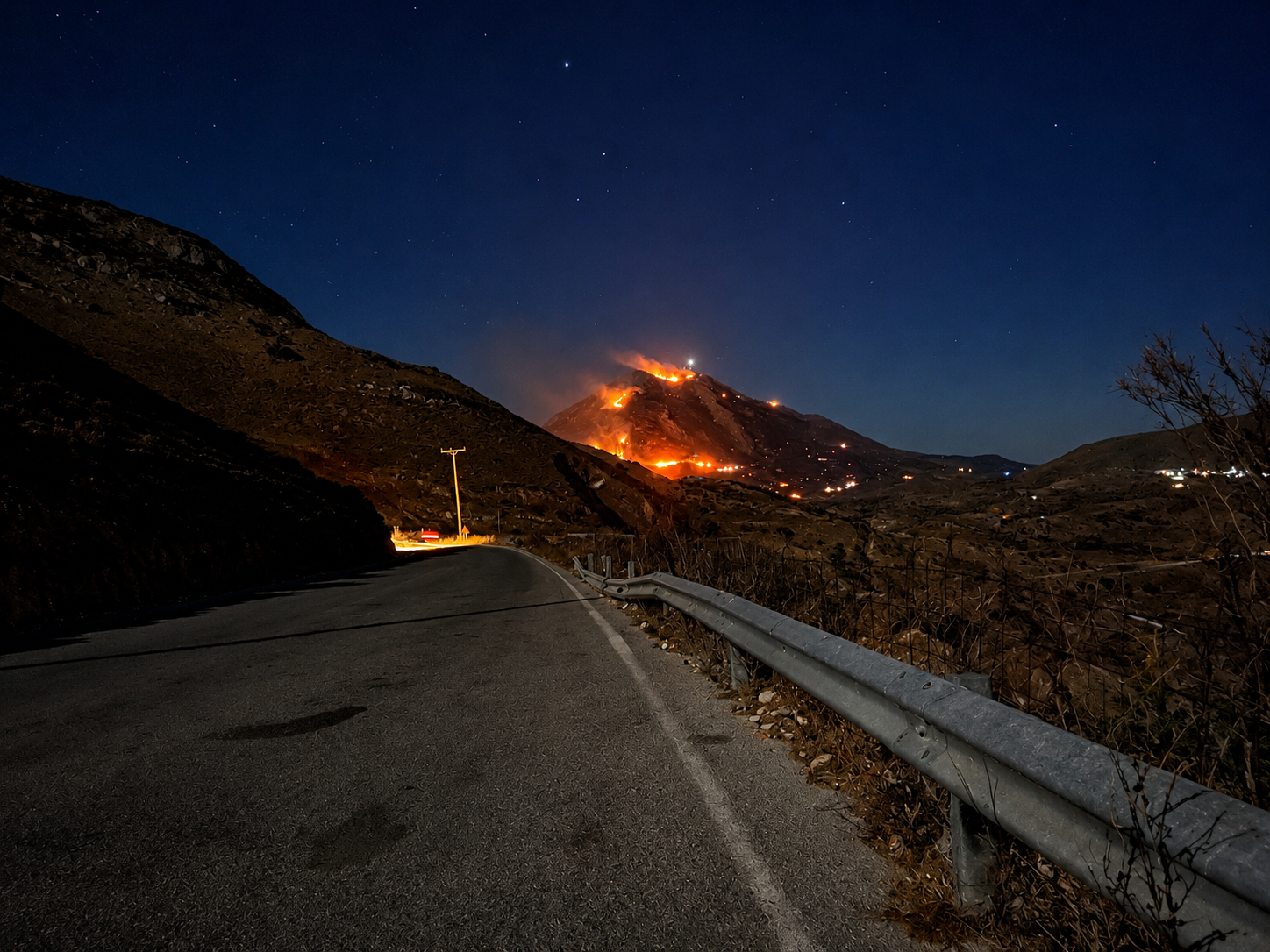
Researchers at the Agricultural University of Athens estimate that almost 95 percent of the roughly 10,000 annual ignitions in Greece are human-caused. Lightning — the dominant natural ignition source in most fire-prone regions of the world — is responsible for only a minority of fires in Greece, and these are generally contained quickly.
The causes of human-started fires range from agricultural burning, negligent disposal of cigarettes, and sparks from machinery, to deliberate arson, for example to clear land or escalate a dispute. According to Greece's Civil Protection Minister, seven out of ten fires in Greece are caused by human factors, predominantly negligence. Intentional arson accounts for an estimated 15 to 30 percent of fires where cause can be established.
In the record 2023 season, 163 people were arrested on fire-related charges by late August — 118 for negligence and 24 for deliberate arson. In 2024, 36 intentional arson arrests were made against 15 for negligence.
What this means is that the increase in fire frequency and intensity over recent decades reflects a combination of factors: climate change is making conditions more dangerous when a fire starts — higher temperatures, lower humidity, stronger winds — but it is not primarily starting the fires. Land abandonment is also a significant contributor: as rural populations have declined and traditional grazing and farming practices have diminished across the Mediterranean, accumulated fuel loads on hillsides have grown substantially, providing more material to burn when ignition occurs. The interaction between these factors — hotter conditions, more fuel, and a constant rate of human ignition — explains the trajectory better than any single cause.
This is not a reason to dismiss the climate dimension. It is a reason to understand the full picture, including the parts that are immediately addressable through land management, enforcement, and rural policy — and the parts that are not.
The 2022 fires near Melambes and Saktouria
For those who know the south coast well, the summer of 2022 is not easily forgotten.
In mid-July, fires broke out in the area between Melambes and Saktouria — the mountain villages above Agia Galini that look down over the valley toward the Libyan Sea, the same villages whose families founded Agia Galini in 1884 and whose olive groves have been producing oil for the plains below for generations. The fires burned through forest, scrub, and cultivated land, driven by winds reaching Beaufort 10. An emergency alert was sent to phones in the area ordering evacuation of Sachtouria and its lower settlement. A state of emergency was declared across several villages including Rodakino, Krya Vrysi, Orne, Melambes, Saktouria, and Agia Galini itself.
The human cost was measured not in lives but in livelihoods. The area around Melambes had recently re-entered Crete's wine map through the efforts of a young local producer who had revived old Vidiano vines and built a winery around the particular character of the hillside. The fire destroyed the vines — ancient, pre-phylloxera plants that had been growing in this soil for more than a century and that cannot simply be replanted and replaced within a human timescale. The olive groves — some of them centuries old — were burned. Families who depended on these groves for their income faced losses measured in decades, not seasons. The winery estimated that Melambes accounted for 80 percent of its production. The fire took most of it.
It was not the first time this specific area had burned. The same hillsides above Melambes and Saktouria had been hit by fires in 2011 and 2015. Each time, the accumulated history of the landscape — the old vines, the centenarian olives, the particular biodiversity of a hillside that had been farmed and grazed and managed over many generations — suffered losses that no recovery grant can fully address.
The 2024 fire in the Amari Valley
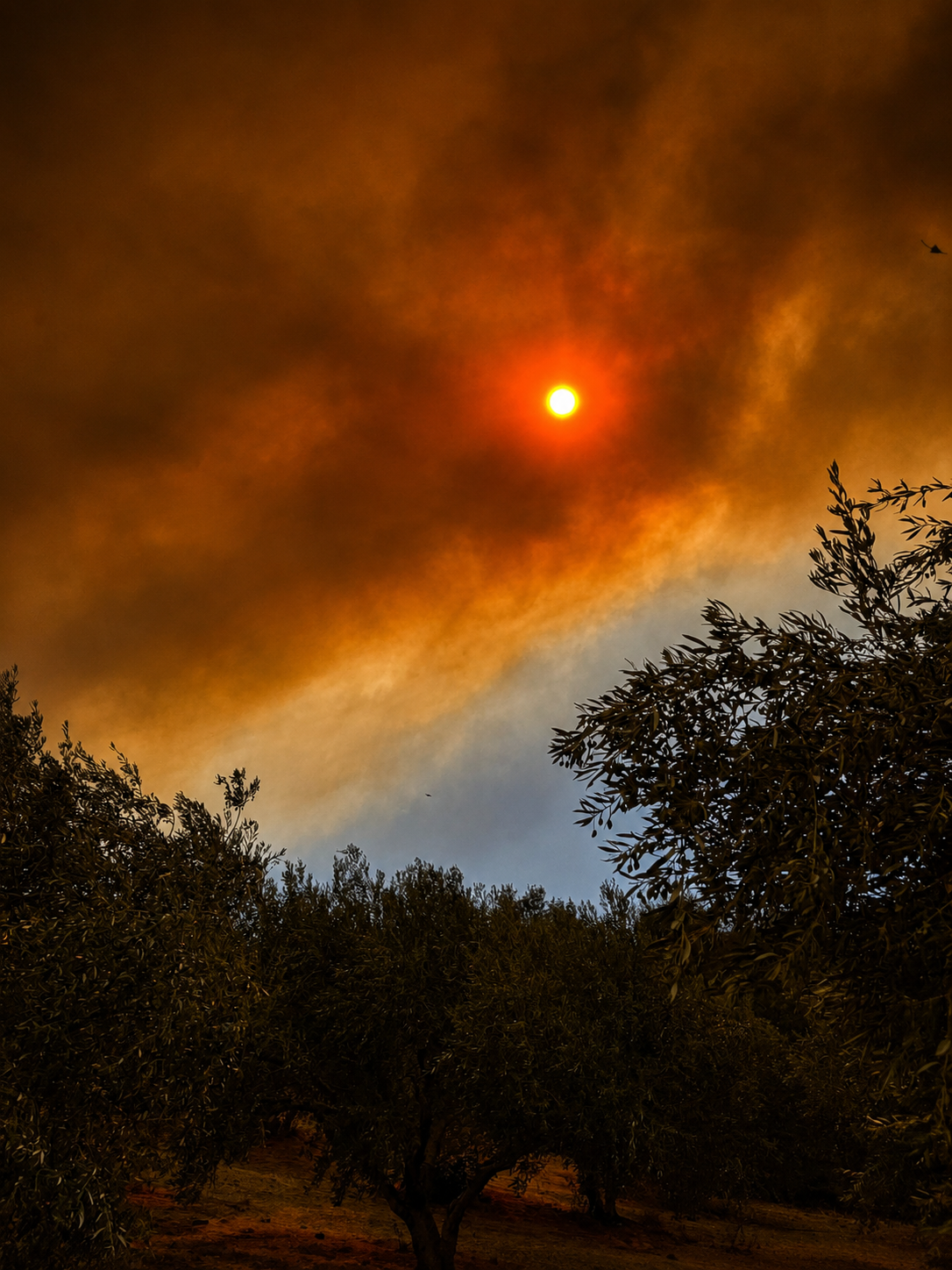
August 2024 brought a larger, more widely covered fire to the region.
Starting on 7 August in the area between Agios Vasileios and Amari municipalities — the beautiful inland valley north of Spili that is one of the quieter and more rewarding destinations for visitors exploring the hinterland of the south coast — the fire burned approximately 750 hectares of forest, scrub, and agricultural land, according to the European Forest Fire Information System. Eight villages were evacuated. The village of Agia Paraskevi in the Agios Vasileios municipality was cleared entirely. Nearly 300 firefighters, 54 fire trucks, 23 aerial units, and earthworks machinery were deployed at the peak of the operation. The Civil Protection Minister flew in to oversee the response.
The fire tore through olive groves and farmland, damaging irrigation networks across the valley. The smoke front was seen from as far away as Agia Galini, where firefighting helicopters refilled their tanks with sea water just behind the harbor walls. Even the village of Klima north of Timbaki was affected and evacuated for a short period. No deaths were reported. The economic damage was substantial: the Municipality of Amari subsequently secured €600,000 for immediate recovery, against an estimated total restoration cost exceeding €1.5 million — covering roads, infrastructure, and civil protection equipment, not the agricultural losses borne by individual farmers.
The Amari Valley — with its Byzantine frescoes, its village squares shaded by ancient plane trees, its tavernas open when someone feels like opening them — is one of the places we most readily recommend to guests wanting to understand the island beyond its coastline. Seeing it recovering from a fire of this scale underscores both how vulnerable the Cretan landscape is in high summer, and how much it holds that is irreplaceable.
2025: fires continue
The summer of 2025 saw fires return to Crete in force. In early July, a fast-moving wildfire near Ierapetra on the south-east coast prompted mass evacuations of hotels and villages, with thousands of guests and residents moved out overnight as gale-force winds drove the flames toward coastal areas. It was a reminder that fire risk on the island is not confined to the inland hills — the entire south coast, with its combination of dry scrubland and summer winds, carries risk through the season.
By mid-summer 2025, the total area burned across the European Union had already exceeded twice the 2006–2024 average, according to the European Forest Fire Information System.
What regenerates, and what doesn't
The ecological picture after a Cretan hillside fire is genuinely complex.
The maquis and phrygana communities that cover much of the landscape are, as noted, adapted to fire. Within weeks of a fire, resprouting plants emerge from protected root crowns. Annuals colonise the cleared ground. By the following spring, the hillside may already show green. Within a decade, in areas that do not burn again, the vegetation can return to something approaching its pre-fire state. This resilience is real.
What does not recover on any human timescale is the agricultural heritage. An olive tree that has been growing for three hundred years cannot be replaced in a single lifetime. Pre-phylloxera vine stock — grown on its own roots, carrying the genetic heritage of grape varieties that existed before the disease swept Europe in the nineteenth century — is effectively irreplaceable once burned. When fire moves through a landscape that carries this kind of accumulated biological and cultural history, the loss is categorically different from what happens when it moves through younger scrubland.
The post-fire risk of soil erosion is also significant. The Cretan hillsides, steep and with thin soils, are vulnerable to flash flooding after fires have destroyed the root systems that hold the ground together. The Amari municipality's concerns about flood protection following the 2024 fires were well-founded: the damage done by water after fire has removed the vegetation cover can, in some cases, exceed the damage done by the fire itself.
What this means for visitors
The honest answer is: less than you might fear, but more than nothing.
The popular coastal areas of Crete — the beaches, the harbour towns, the resort villages — are rarely threatened directly by the fires that burn in the hills and mountains. The 2024 Amari fire received significant press coverage but posed, in the words of the reporting at the time, no immediate threat to the busy holiday resorts along the island's coast. The 2025 Ierapetra fire was more directly coastal and did require hotel evacuations, but guests were moved safely and the emergency response was organised.
Fire risk is highest in August, when temperatures and wind conditions are at their most dangerous. For visitors to the south coast, the precautions are straightforward: do not light fires or barbecues outdoors during high-risk periods (clearly signposted and sometimes banned by local authority order), do not discard cigarettes from vehicles, and be aware of evacuation routes from wherever you are staying. Most years, these precautions are never needed. Some years, they are.
What helps is having someone on the ground who knows. Our team at STAYS by The Grove Crete monitors conditions throughout the fire season and stays in direct contact with guests across all our properties — providing real-time information if a situation develops nearby, coordinating any necessary response, and making sure that whatever happens on the hillside stays well away from your holiday. It is one of the less glamorous aspects of what a locally based management team does, and one of the most valuable.
The broader significance of the fires for a visitor to Crete is perhaps less about personal risk than about understanding what you are looking at when you drive through a hillside of low silver-grey scrub or a valley of ancient olive trees. These landscapes carry a history that goes back further than the tourism industry, further than the villages, further than the Byzantine churches and Minoan palaces. They are also, in the current period, more vulnerable than they have ever been. Travelling through them with that awareness is not a less enjoyable experience. It is a more complete one.
If the natural world of the south coast is part of what draws you, the STAYS Journal's guide to botanical Crete covers the plant life of these hillsides in detail — including many of the species that are fire-adapted and that return first after a burn. Our piece on wildlife in Crete is the companion read. For those who want to walk through this landscape directly, our guide to hiking in South Crete covers the gorges and coastal trails that take you through it, and safe hiking in South Crete addresses the practical precautions — including summer heat — that apply to any walk in August.
One more connection worth making: the Melambes fire of 2022 destroyed vineyards that had been part of a quiet revival of ancient Cretan grape varieties — old Vidiano vines that had survived phylloxera and were producing wines of genuine character. The story of Cretan wine, and why so much of it never leaves the island, is covered in the Journal's piece on Cretan wine and the revival of ancient grapes. It is a good read alongside this one.
Our Home Collection includes villas across the south coast, each within the landscape described above. Fires are part of that landscape. So is everything that grows back.
