
The Ultimate Guide to Agia Galini, South Crete
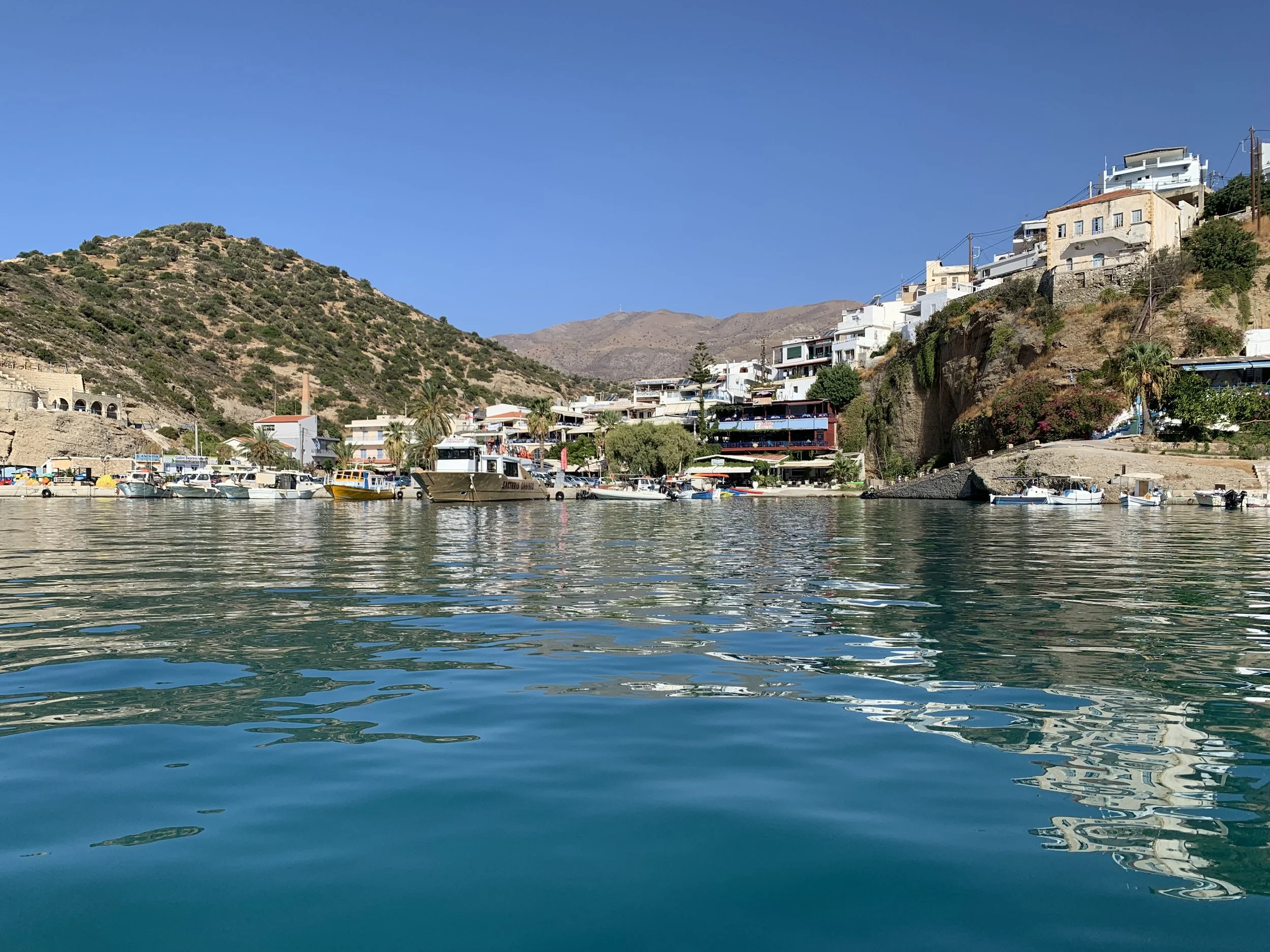
Agia Galini divides opinion. There are people who have been coming here every summer for thirty years and would not consider going anywhere else. There are first-time visitors who arrive expecting a picturesque Cretan fishing village and find something rather more complicated, but become repeating visitors nonetheless. The truth, as usual, is somewhere in the middle — and understanding it before you arrive makes the experience considerably more satisfying.
What Agia Galini offers, at its best, is genuine: a natural harbour of real beauty, a setting that the hills and sea conspire to make spectacular, a concentrated village life that the north coast's resorts lost a long time ago, and access to some of the finest coastline and ancient landscape on the island. What it does not always offer is the polish you might expect from a destination that has been receiving tourists since the 1970s. Agia Galini is a work in progress — and lately, a more interesting one.
A place that goes back further than its tourism
Most of what visitors see in Agia Galini was built in the last fifty years. The settlement itself is just a little bit older: the current village was founded in 1884, when families from the nearby mountain villages of Melambes and Saktouria moved to the coast, built warehouses, and began exporting the olive oil from the Messara Plain through this natural harbour. Before that, the bay had been used for centuries as an anchorage — for Venetian traders, for ships supplying the Cretan revolts against Ottoman rule in 1821 and 1866 — but there was no permanent community here.
Beneath all of that, however, is something considerably older. Agia Galini stands on the site of the ancient city of Soulia, which served as the coastal settlement of the inland city of Syvritos, a flourishing centre in the foothills of Psiloritis. Soulia maintained a temple to the goddess Artemis — two granite columns from that temple now stand, somewhat incongruously, inside the village church. They are the longest continuous thread in a place that otherwise wears its history lightly. The city survived into the Byzantine period before being destroyed by Arab pirates in 640 AD.
A small piece of more recent history survives above the harbour. Most visitors walk past the old wartime tunnel cut into the cliff without noticing it. Built during the German occupation of Crete in the Second World War, it runs through the rock above the beach and formed part of the military infrastructure that once overlooked the bay. It is not a museum and there is little interpretation on site, but it remains one of those details that remind you how many different layers of history coexist in Agia Galini — from Minoan harbours and Byzantine churches to the twentieth century.
The name Agia Galini itself has its own legend. According to the most widely told version, the Byzantine Empress Eudocia was caught in a violent storm off this coast while travelling to the Holy Land. She prayed for deliverance and vowed to build a church if the ship reached safety. It did. The church she built — Panagia Galini, the Virgin of Serenity — gave the bay its name. Galini means serenity in Greek. The sea here, sheltered by the surrounding hills, is often calm enough to deserve it.
The village today
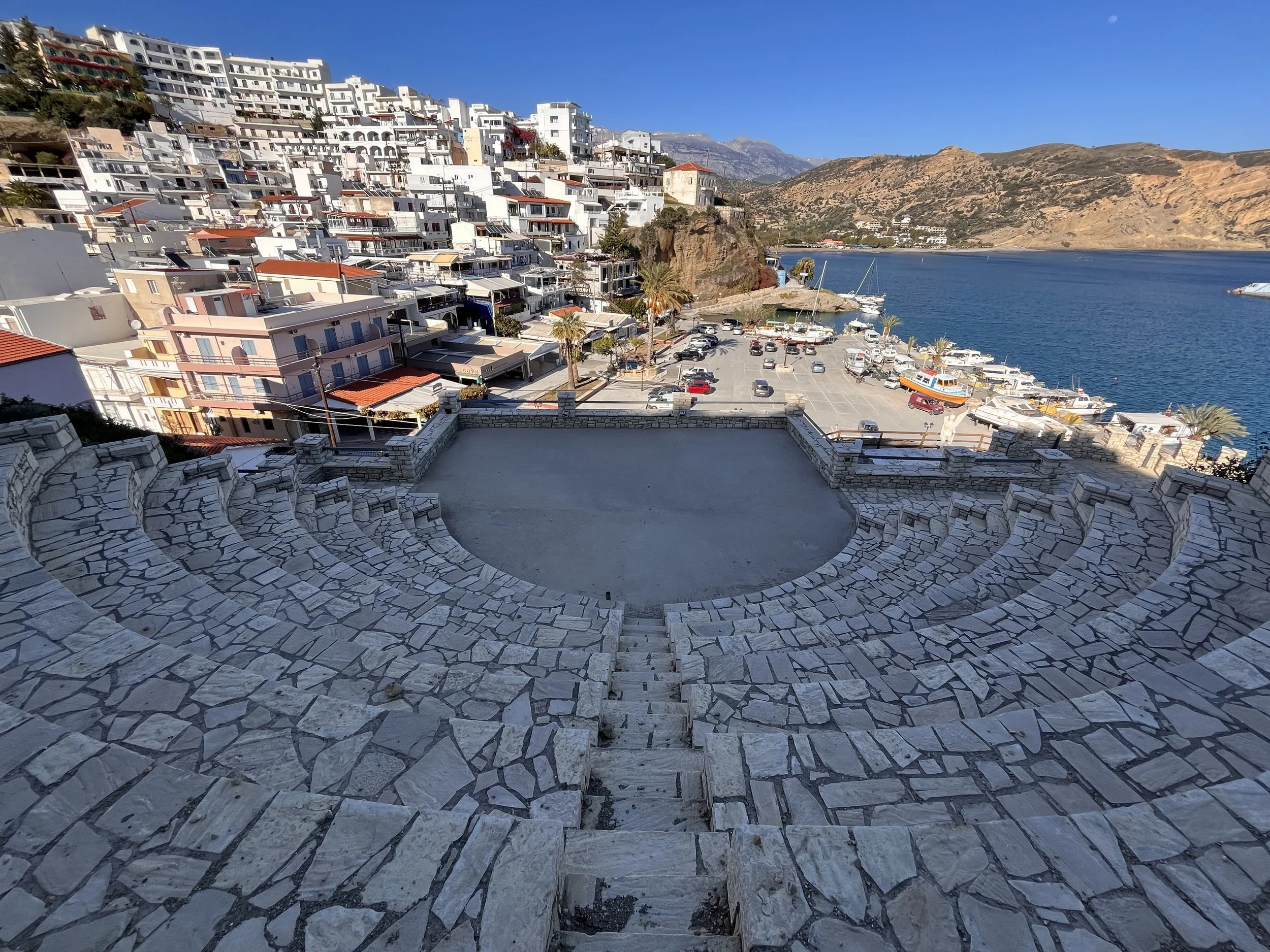
Agia Galini is built on a steep hillside, the houses stacked amphitheatrically above a harbour that opens south toward the Libyan Sea. From above — from the newer developments climbing the slopes above the centre, or from a boat heading back from one of the nearby beaches — the arrangement is genuinely beautiful. The bay sweeps in a wide arc, the Paximadia Islands sit on the horizon, and the village glows white against the hill in the afternoon light.
At street level, the picture is more mixed. The main pedestrian lanes running down toward the harbour are lined with restaurants, bars, shops, and accommodation of varying vintage and quality. Some of it is worn around the edges in the way that Cretan resort towns tend to get when high season brings full occupancy and the pressure to serve large numbers quickly. Yet that slightly unpolished quality is also part of what separates Agia Galini from the more curated destinations on Crete's north coast. The village works hardest for itself in July and August, when the harbour is animated and the streets busy. Many visitors enjoy the main season’s hustle and bustle, the people-watching. But many prefer May, June, September, and October.
What the village retains, and what keeps people returning, is something harder to quantify. The harbour front in the evening — fishing boats still in the water, the tables set out along the promenade, the particular smell of the sea mixing with whatever is being grilled — has an authenticity that the north coast gave up a long time ago. This is still, at its core, a place where people live year-round, where the baker knows the fisherman, where the rhythms of the season have not been entirely replaced by the rhythms of the tourist industry.
Signs of change
The more interesting story in Agia Galini right now is what is happening at its edges.
The hillside above the village centre has seen a wave of newer development — private apartments, contemporary residences, small complexes with pools and sea views — that represent a different version of what a stay here could look like. Developments like Galini Breeze and others that have appeared in recent years offer the light, the views, and the access to the harbour below, without the noise and the density of the centre.
Within the village, the shift in generations is also quietly visible. Younger people who have taken over from their parents in the hospitality sector tend to bring a different sensibility to the job — more attuned to what contemporary travellers expect, more willing to invest in quality and presentation. Chris & C Apartments is one example of this generational shift: a property that reflects a more considered approach to what contemporary accommodation can look like.
At the hotel end of the market, Paralos Irini Mare — the four-star property set on a gentle hill above the bay, with its Mediterranean garden, geothermal energy system, and cuisine built around local and organic produce — represents the most established example of what quality hospitality looks like in this corner of Crete. Committed to sustainability and local sourcing in a way that goes beyond the usual claims, it has built a loyal clientele and operates at a level noticeably above the village average. Established hotels, such as Palazzo Greco, invest a lot in keeping their hotels updated, with the latest renovation just completed. Near the harbor, Rea Boutique Apartments offers modern rooms and a well-equipped gym that is open for non-guests as well.
The overall direction of Agia Galini is, slowly, upward. It will not happen overnight, and there are parts of the village that still feel stranded in an earlier decade of Cretan tourism. But the raw material — the harbour, the bay, the position on the south coast — is exceptional. What gets built on top of it is gradually becoming more worthy of it.
Of course, as anywhere in the world, gentrification brings discontent among older residents and, especially, visitors who resist the change. This is apparent in Facebook groups, where discussions rage about almost every new development or major modernisation project. But then, change is necessary for Agia Galini to attract the returning visitors of the future.
Where to eat and drink
Agia Galini has a broad range of restaurants and tavernas, and the honest approach is to explore rather than rely on any single recommendation. Standards vary, but are generally consistent; the best way to read a place is to walk past at lunchtime and observe who is eating there and what is on the plates.
That said, two establishments consistently stand out for their quality and reliability. The Balloon Bar, on the harbour front, is one of those rare places that manages to be genuinely good at everything it attempts — a day-to-night operation that runs from breakfast through cocktails, with fresh juices, well-made coffee, a kitchen open later than almost anywhere else in the village, and a terrace that faces the harbour and makes a strong case for staying longer than you planned. Run by brothers Manolis and Nikos Papamihelakis since 2012, it has earned its reputation without compromising it.
Onar, near the harbour with views of the harbour, is the local answer to the question of where to go for a proper dinner. Traditional Cretan cooking, good portions, an honest approach to local ingredients, and a setting that makes the meal feel like the event it should be.
For the rest, the village rewards curiosity. The narrower alleys away from the main tourist strip occasionally hide smaller tavernas that have been feeding the same local clientele for decades and have no particular interest in impressing anyone beyond the quality of what they cook.
The harbour and the bay
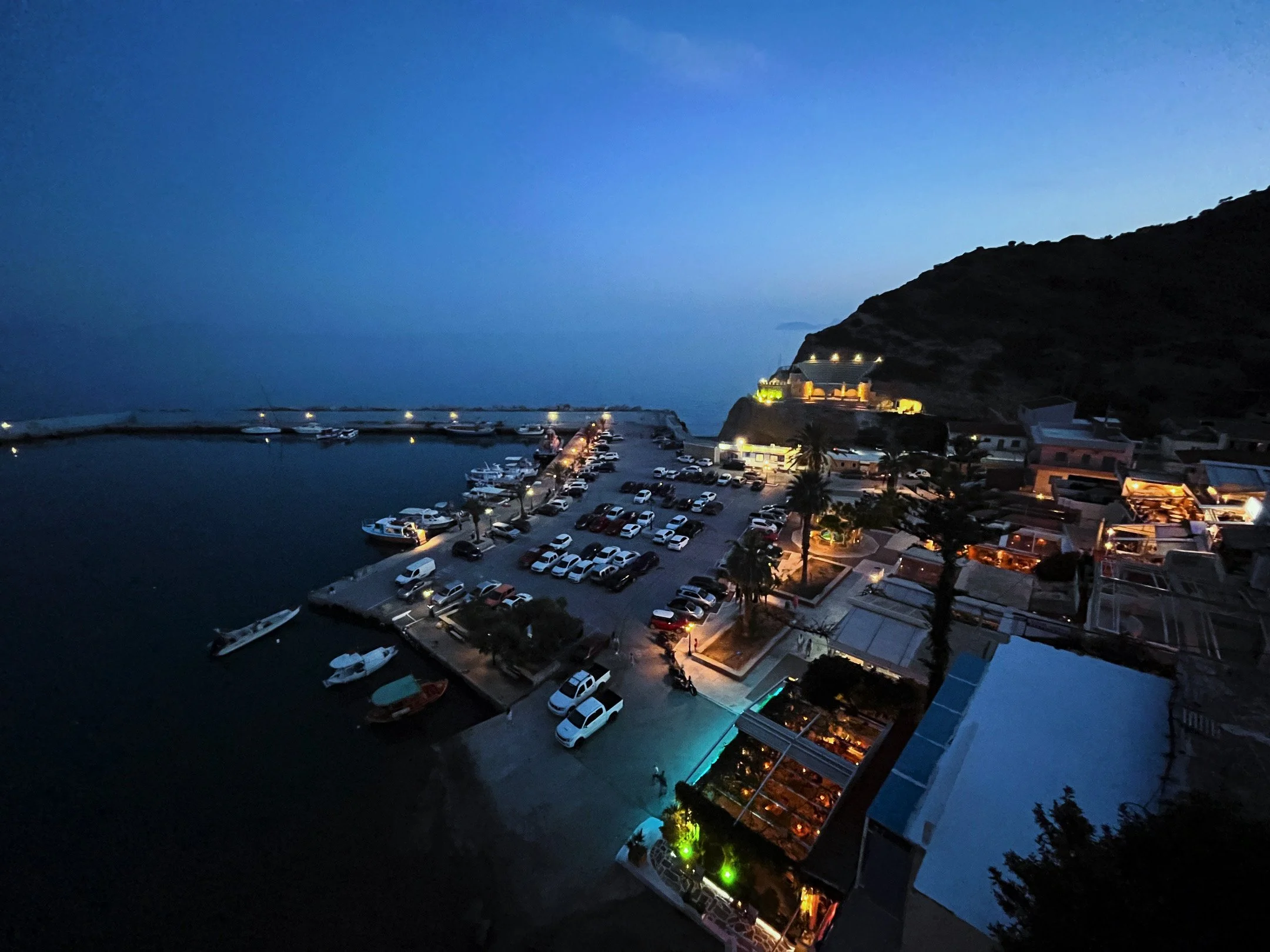
The harbour is the best part of Agia Galini, and spending time around it — in the morning when the fishing boats are returning, in the evening when the promenade fills with people — is to understand why people come back year after year regardless of the village's shortcomings.
From the harbour, boat trips run daily in season to the nearby beaches — Agios Georgios, Agios Pavlos, Agiofarago — as well as along the coast to the caves and coves that are not reachable by road. The cave the locals call the Cave of Daedalus, on the western cliff face, is one of the destinations; the myth holds that Daedalus and Icarus began their ill-fated flight from this coast. There is also a Roman shipwreck from the third century AD in the bay, discovered by divers and adding an underwater chapter to the area's long history. For those interested in exploring the wider coastline, the STAYS Journal's piece on the hidden archaeology of South Crete covers what lies beneath and beyond the village.
The beach in the village centre is practical rather than remarkable — it serves its purpose in high season and is a short walk from everything. The better beaches require a short drive or a boat.
The beaches near Agia Galini
The south coast does not give up its best beaches easily, which is precisely why they remain the way they are. For a full guide to the coastline, see our beaches guide. In brief:
Agios Giorgos is the closest — a walk along the coastal path or a short drive, long and calm enough for families, with just enough facilities. Agios Pavlos, further west, offers sand dunes, dramatic rock formations, and small tavernas. Triopetra — the Three Rocks, named for the formations rising from the water offshore — splits into two beaches around a headland, both long, both quiet. Between Agios Pavlos and Triopetra, a series of hidden coves accessed by dirt road or on foot along the coast offer the closest thing to solitude the south coast provides. Kommos, Matala, Red Beach, and Agiofarago, east along the coast, are all well worth the drive (or boat trip).
Agia Galini as a base
The location is the strongest argument for Agia Galini. The village sits at the convergence of the south coast, the Messara Plain, and the foothills of Psiloritis in a way that makes it one of the most well-positioned bases on the island.
The Palace of Phaistos is 25 minutes away. Agia Triada, the smaller Minoan site, is similarly close. Gortyna is 40 minutes east. Matala, with its famous cliff caves, is also 40 minutes away. The Amari Valley — mountain villages, Byzantine churches, one of the most quietly beautiful drives on the island — is accessible in under an hour. The Archaeological Museum in Heraklion, home to the Minoan collection and the Phaistos Disc, is ninety minutes north. Our guide to the Palace of Phaistos and guide to the museum cover both in detail.
For anyone who wants to use a base on the south coast to explore the island seriously — combining beaches, ancient sites, mountain villages, and the particular rhythm of Cretan life in its less touristed form — Agia Galini earns its position.
Where to stay
The accommodation landscape around Agia Galini is broader than the village centre suggests. The hillsides above and around the village, and the coastal cliffs to either side, offer a range of privately managed villas and houses that give you access to everything the area offers without the noise and density of the centre.
Keras Cliff House, on a private cliff above the Libyan Sea just outside the village, is the area's most distinctive rental property: an award-winning architectural villa sleeping up to twelve guests, with an infinity pool, private spa, padel court, and uninterrupted views of the sea and the Paximadia Islands. It is a particularly good base for groups who want to use the south coast seriously — as a place to be between excursions, as much as the excursions themselves.
Villa Ninemia, a modern three-bedroom home near Agia Galini with a private pool and open countryside and sea views, offers a more relaxed and accessible introduction to villa life in this part of the island — well located, well equipped, and honest about what it is.
Villa Francesca, a spacious three-bedroom home near Agia Galini, is well suited to families or larger groups who want space, proximity to the village and its beaches, and a comfortable base for the week.
For those still deciding between the Agia Galini area and other parts of the south coast, our Home Collection includes villas near Agios Pavlos, Triopetra, and Plakias, and our guide to where to stay in South Crete covers the character of each area honestly.
The honest verdict
Agia Galini is not the south coast at its most refined. It is the south coast at its most alive — complicated, improving in fits and starts, and possessed of a natural setting and a position on the island that no amount of uneven development can undo.
Go in May or June, when the light is extraordinary and the crowds have not yet arrived. Spend your mornings at Phaistos or on the water. Eat at the harbour in the evenings and stay long enough for the place to stop being a resort and start being a village. The rewards are genuine, and they are, as with most things in South Crete, earned rather than handed to you.
That is, arguably, precisely the point.
