
The Palace of Knossos: Is It Worth Visiting?
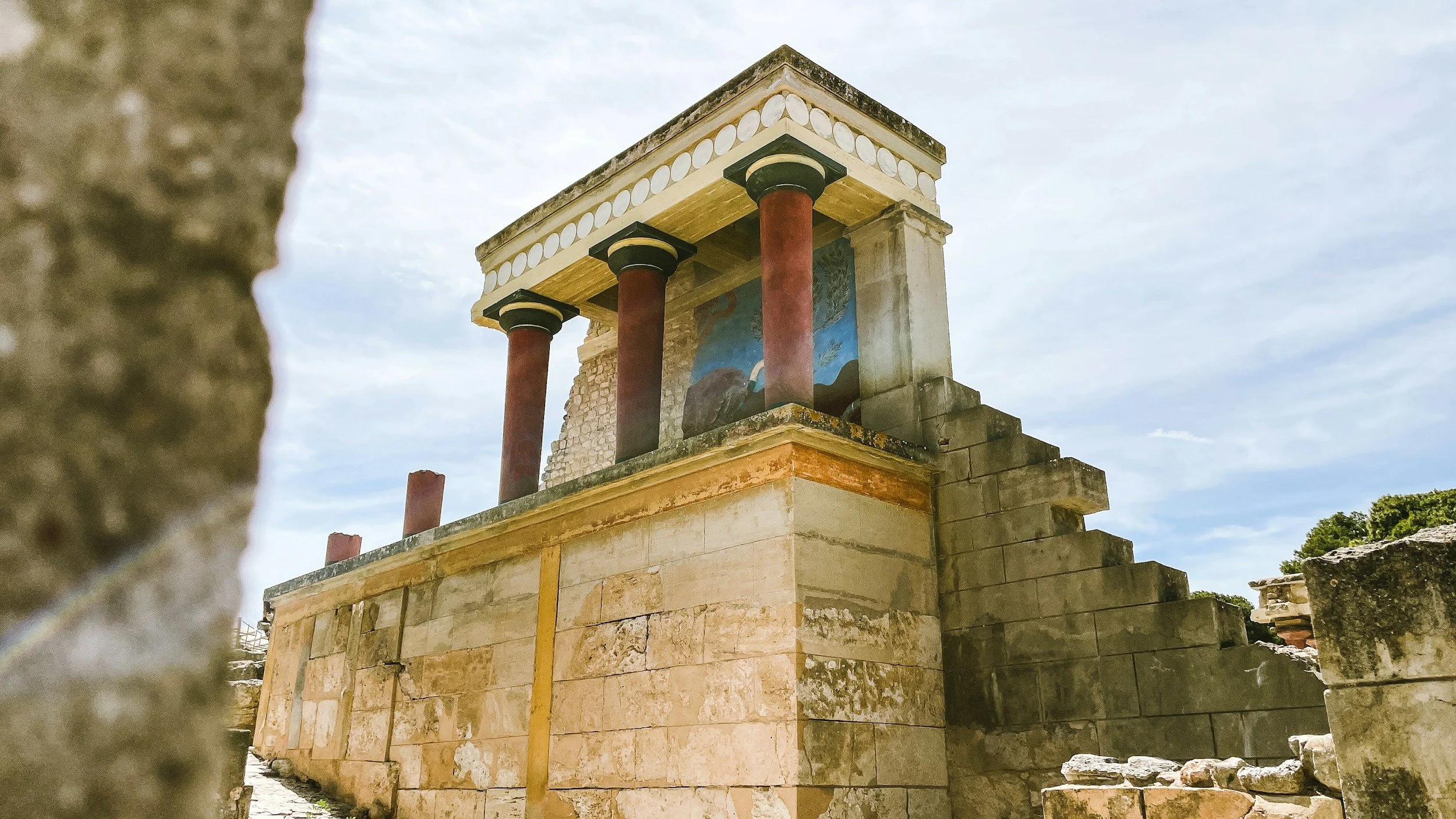
Whether to visit the Palace of Knossos is one of those questions that comes up on almost every holiday to Crete, usually around day two, somewhere between planning the beaches and wondering whether Heraklion warrants a morning. Our answer is yes — but with a candour that most travel guides tend to skip.
Knossos has disappointed visitors before. It will disappoint some again. Knowing why it disappoints them, and why it remains worth visiting despite this, makes for a considerably better experience than arriving with unchecked expectations.
What you are actually looking at
The palace — or rather, the complex of structures that archaeologists continue to debate calling a palace — dates from the Bronze Age, broadly the second millennium BCE. At its height, this was the administrative and ceremonial heart of Minoan civilisation: Europe's first advanced culture, pre-dating classical Greece by more than a thousand years. The Minoans built roads, managed drainage systems, ventilated multi-storey buildings, and produced art of a sophistication that still commands genuine admiration in Heraklion's Archaeological Museum.
What stands at Knossos today is not quite the Bronze Age and not quite a ruin. It is something in between — the result of excavation, interpretation, and, in places, outright invention — and understanding that layered history is what turns a potentially underwhelming visit into a genuinely fascinating one.
If you find yourself drawn to the island's ancient past, the STAYS Journal has a dedicated piece on the forgotten archaeology of South Crete — the quieter Minoan sites that lie well beyond the tourist trail, following the work of archaeologist Sinclair Hood along the Libyan Sea coast.
The Arthur Evans problem
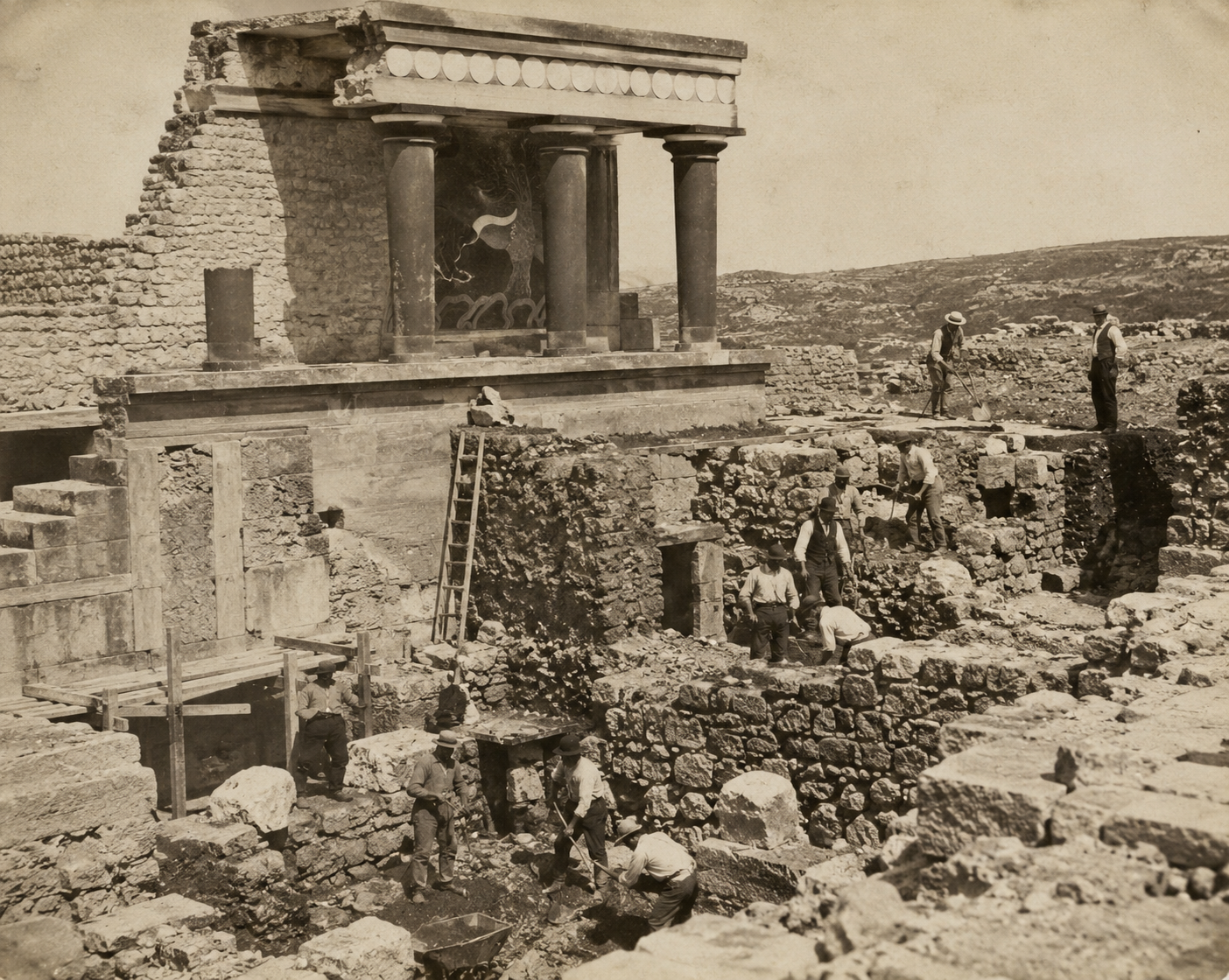
Arthur Evans arrived at Knossos in 1900, when archaeology was still finding its method. He had come to the island partly in search of evidence for the myths he had grown up reading — Homer, the legend of Minos, the labyrinth and the Minotaur. He found something extraordinary. What he did with it is more complicated.
Evans reconstructed. Extensively. He rebuilt columns in concrete, repainted frescoes based on fragments that left enormous room for interpretation, and named rooms according to what he believed — or needed — them to be. The "Throne Room." The "Queen's Megaron." The "Grand Staircase." These names have stuck, partly because they are useful and partly because they have been repeated so many times that they have taken on an authority Evans never earned.
The results are still visible everywhere at the site. Much of what looks like Minoan architecture is Evans's early twentieth-century vision of Minoan architecture. The colours, bold and vivid, reflect his imagination as much as any ancient evidence. Generations of archaeologists have spent careers trying to separate what was actually there from what Evans wanted to find — a task made considerably harder by the fact that he excavated quickly, with large teams, at a time when stratigraphic precision was not yet the standard it became.
What we think we know, and what we don't
Linear B, the script in which surviving Minoan administrative records are written, was partially deciphered in the 1950s by Michael Ventris, who demonstrated it to be an early form of Greek. Linear A, the older script used for religious and other purposes, has not been deciphered and may never be. The Minoans, in a meaningful sense, cannot yet speak for themselves.
This gap has allowed assumptions to fill the space. Evans assumed a king. He assumed the narrative of Minos — son of Zeus, husband of Pasiphaë, father of Ariadne, builder of the labyrinth where Theseus slayed Ariadne’s half-brother, the Minotaur. Evans arranged what he found to support that story.
More recent scholarship suggests a different picture. The absence of royal iconography, the lack of royal tombs at Knossos, the prominent role of female figures in Minoan art and religious imagery — all of this points toward a society that may have been significantly more egalitarian than Evans envisioned, possibly matriarchal in its religious organisation, possibly not ruled by a king at all. The "throne room" may have been a ceremonial space for a head priestess. The "palaces" may have functioned as communal buildings — places of storage, redistribution, assembly — rather than royal residences in any sense we would recognise.
Even the name Evans gave this civilisation carries the weight of his assumptions. "Minoan" after Minos — a mythological king. The people who built Knossos may have had no relationship to that name whatsoever.
And then there are the darker findings. Archaeological evidence from a site near Knossos suggests that the Minoans, in the later period of their civilisation — as things began to go wrong, as climate events and possibly volcanic activity from Santorini began to destabilise the world they had built — sacrificed children. Whether this was desperation or ritual, or both, remains uncertain. It sits awkwardly alongside the art, the frescoes of young people leaping over bulls, the elegant ladies of the court. Civilisations, like people, contain multitudes.
Before you go, it is worth reading up. The STAYS Journal's literary guide to Crete includes several books that bring the Minoan world into focus — reading one in advance transforms what you see at the site considerably.
Why it is still worth going
None of the above is a reason to stay home. It is, if anything, a reason to go more prepared and to find the experience more interesting than the photographs suggested it would be.
The scale of the complex is not as large as visitors sometimes expect — this is one of the more common sources of disappointment — but what it does convey, clearly, is the sophistication of what was here. The drainage channels. The light wells that brought air and daylight into the lower floors. The storage magazines with their great ceramic pithoi still in place. The spatial logic of a building designed for large numbers of people, for ceremony, for administration, for storage of grain and oil and wine. Whatever this place was called by the people who built it, it was remarkable.
The fresco reproductions at the site — the originals are in Heraklion's Archaeological Museum, which is a separate visit and arguably a more rewarding one for the art itself — give a sense of Minoan visual culture: the dolphins, the bull-leaping, the processions. Filtered through Evans's restorations, yes, but rooted in something real.
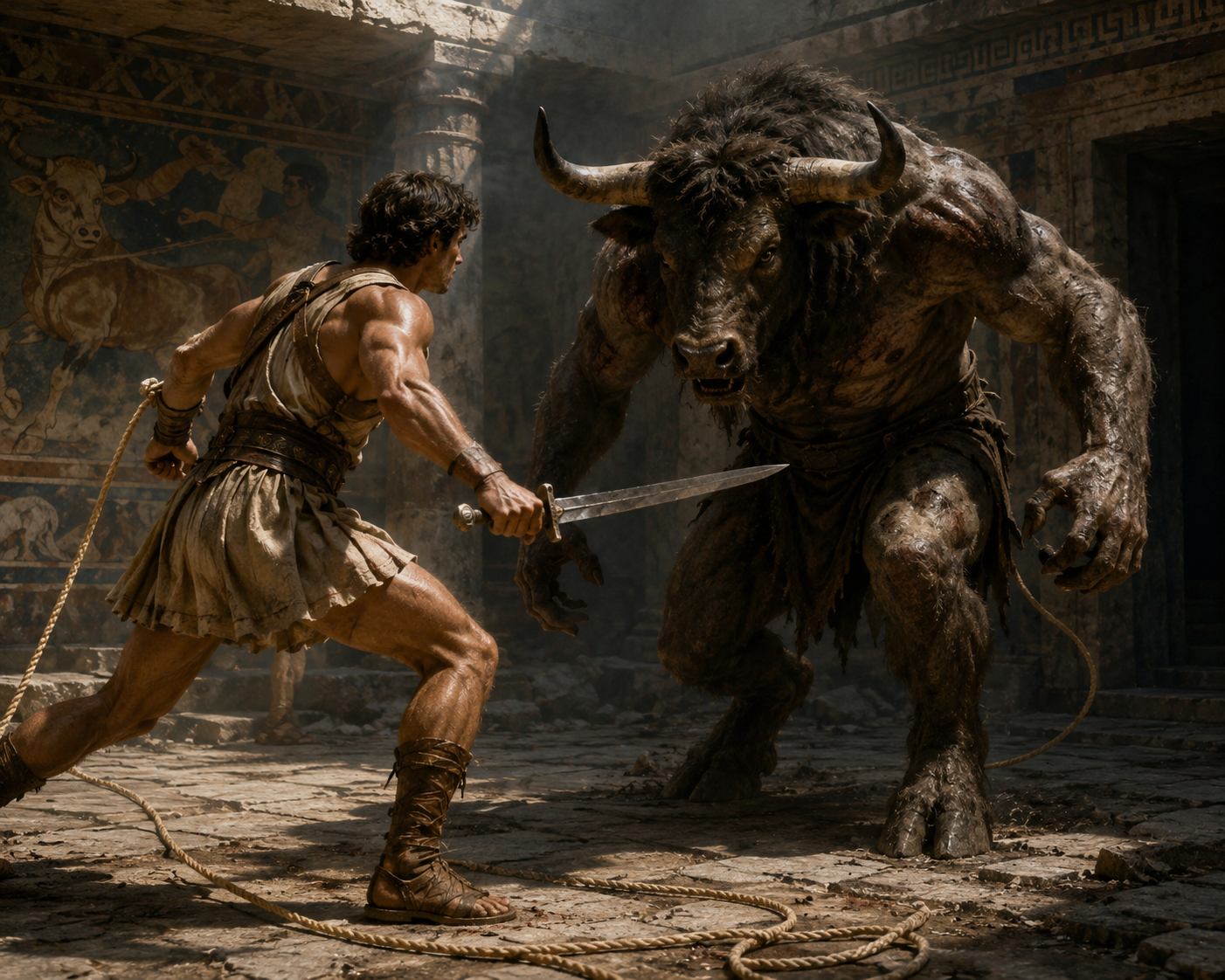
And the myths that Knossos inspired are, in themselves, part of what you are visiting. The labyrinth. The Minotaur. Theseus and Ariadne. These stories did not come from nowhere. The complex of rooms at Knossos, the corridors that branch and double back, the sense of a place designed on a scale and logic not immediately legible to an outsider — this is where the myth took root. Standing inside it, even in its reconstructed state, makes that legible in a way that no museum exhibit quite does.
How to make the most of it
Go with a guide, or at least with a good book in hand before you arrive. The site without context is a collection of reconstructed walls and labelled rooms that passes in an hour and leaves you uncertain what you saw. With context — with some understanding of who Evans was and what he did here, of what the Minoans may actually have been, of the myths that grew from this place — it becomes something considerably more layered.
Visit the Archaeological Museum in Heraklion either before or after. The original frescoes, the jewellery, the pottery, the Phaistos Disc — still undeciphered, still debated — are there. Knossos and the museum together make a full picture. Separately, each is incomplete.
Go early, before the tour groups arrive from the north coast hotels. The site becomes crowded by mid-morning in high season. If you are wondering how to structure your time on the island more broadly, our guide to how many days you need in Crete covers how to balance the north and south without feeling rushed.
And arrive willing to sit with uncertainty. The Minoans remain, despite everything Evans believed he had established, a civilisation we understand imperfectly. That not-knowing is not a failure of the visit. It is, in a way, the most honest thing Knossos has to offer.
Where to stay
Knossos sits five kilometres south of Heraklion — in the north of the island. But most visitors who come for a week or more find the south coast a more rewarding base: quieter, wilder, and within easy reach of Phaistos, the second great Minoan palace, which sits on a hilltop above the Messara Plain twenty minutes from Agia Galini. If you are weighing up where to anchor yourself, our guide to where to stay in South Crete lays out the differences between the main areas honestly.
From a south coast villa, Knossos is a natural day trip north — ninety minutes by car, with the Archaeological Museum and the old city of Heraklion filling the afternoon on the way back. The evening returns you to the Libyan Sea, a long dinner, and the particular quality of the south coast sky after dark. If that appeals, our stargazing guide explains why the south coast is one of the better places in the Mediterranean for it.
Our Home Collection includes villas across the south coast — from clifftop houses above the sea near Agia Galini to quieter retreats above Plakias and Triopetra. Each is a short drive from Phaistos and a comfortable day trip from Knossos. If you are planning a holiday that combines the ancient world with the best of the island's coastline, the south is where to be.
The Minoans built something that has outlasted every civilisation that followed them on this island. It deserves a morning of your week here. The rest of the time, the south coast will take care of itself.
Phaistos, the second great Minoan palace, is covered in more detail in the STAYS Journal. The Archaeological Museum of Heraklion houses the finest collection of Minoan artefacts in the world and warrants a separate visit. To plan your drive north from the south coast, see our guide to driving in Crete.
